
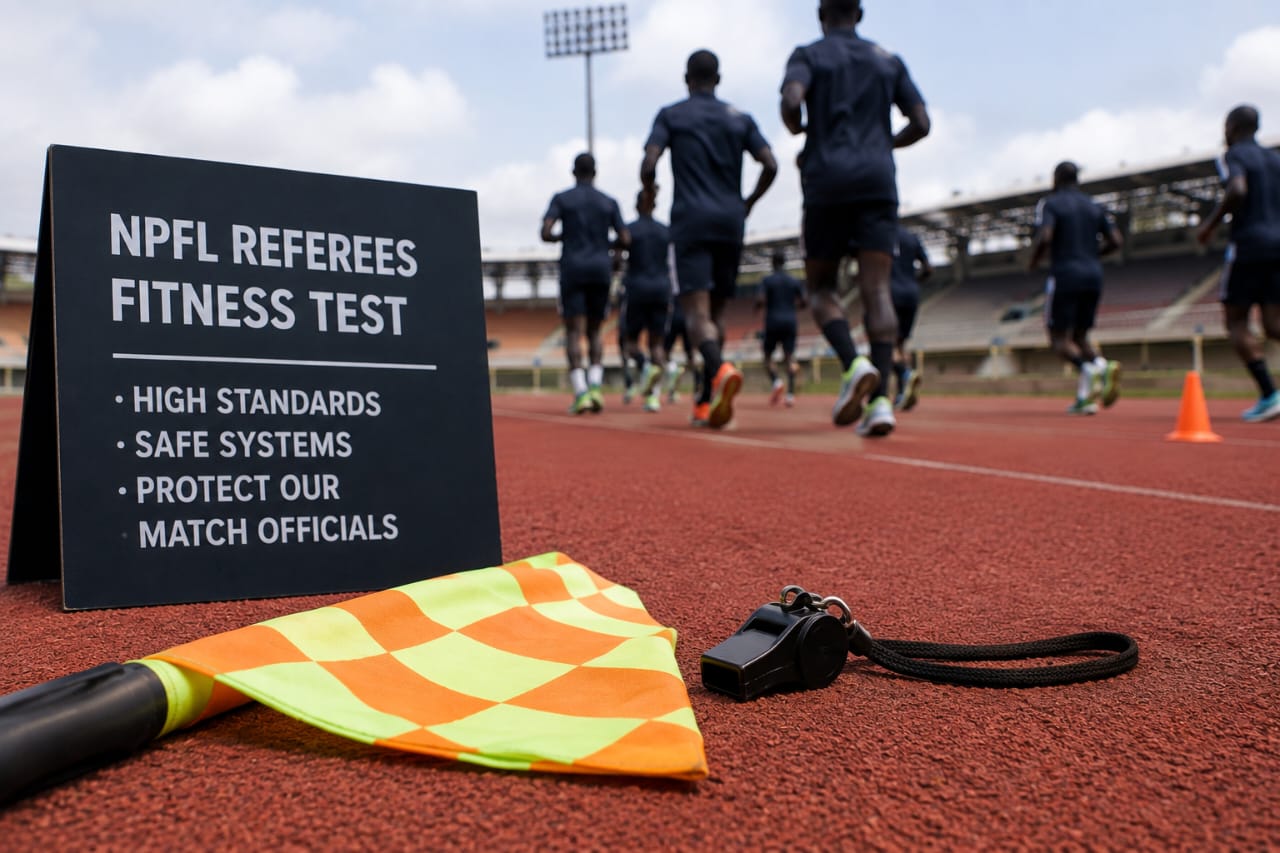
An active Nigerian referee has called for an urgent review of the physical fitness requirements for match officials following the death of Plateau State referee Aweng Solomon Maram during a pre-season assessment in Abuja.
Sports247 reports that Maram reportedly collapsed and died on Tuesday, August 18, while taking part in the fitness exercise at the MKO Abiola National Stadium as referees prepared for the 2026/27 football season. His death has sent shockwaves through the Nigerian refereeing community.
Speaking on the development, the referee questioned whether Nigeria’s current fitness requirements are unnecessarily demanding and urged the relevant authorities to examine the standards being imposed on domestic match officials.
The referee’s concern centres particularly on the reported 12-lap requirement, arguing that Nigeria should adhere to internationally recognised standards without adding physical demands that may expose referees to unnecessary risks.
“If he had stopped at 10 laps, he may still be alive,” the referee suggested, while acknowledging that the circumstances surrounding Maram’s death must first be properly established before any conclusion can be reached.
The comment does not establish that the number of laps caused Maram’s death. Rather, it reflects growing concern within the refereeing community about whether the physical demands placed on officials are being matched by adequate medical safeguards.
Questions surrounding the 10- and 12-lap requirements are not entirely new. Previous reporting has documented disagreements within Nigerian refereeing circles over the use of a 12-lap requirement compared with the 10-lap standard associated with FIFA and CAF testing.
The latest tragedy has therefore brought the issue back into focus.
The referee argued that the priority should not simply be to make officials pass increasingly demanding fitness tests, but to ensure that the tests accurately measure the physical readiness required to officiate matches while protecting the health and safety of participants.
Another referee, who also works as a gym instructor, raised a separate concern over the quality of medical examinations conducted before officials are cleared for physically demanding assessments.
He questioned whether referees routinely undergo sufficiently comprehensive cardiac screening, including examinations such as electrocardiograms (ECGs), before participating in national fitness tests.
The concern is particularly significant given the intensity of the exercise and the potential for previously undetected medical conditions to become apparent during strenuous physical activity.
Maram’s death has consequently raised two related questions for Nigerian football authorities: whether the physical requirements are appropriate and whether the medical screening process is sufficiently robust to identify officials who may be at risk.
The Nigeria Football Referees Association has mourned Maram, describing him as an elite NPFL referee and one of the country’s respected match officials.
But beyond the tributes, the incident has intensified calls for a comprehensive review of the procedures surrounding referee fitness assessments.
Such a review could examine the scientific basis for the number of laps required, the medical tests conducted before the exercise, emergency medical arrangements at testing venues and the procedures for responding when a referee shows signs of distress.
For the refereeing community, the issue is ultimately bigger than whether officials should run 10 or 12 laps.
It is about ensuring that the pursuit of physical excellence does not come at the expense of the health and welfare of the match officials on whom Nigerian football depends.
The circumstances surrounding Maram’s death must be thoroughly established. But his passing has already raised questions that Nigerian football authorities will need to confront if they are to ensure that future fitness assessments meet professional standards while providing the strongest possible protection for referees.