Horse racing may not sit alongside football in the everyday sporting conversation for many Nigerian fans, but it has plenty in common with the way we already follow fixtures, team news and form. There’s a schedule to study, statistics to weigh up and plenty of information to separate from noise.
At its core, horse racing is a contest in which horses and jockeys compete over a set course and distance. It’s one of the world’s oldest organised sports, with formats and traditions that differ between countries. The history of horse racing in Monopoly Casino stretches back centuries, but the modern viewing experience is familiar: race meetings, published racecards, commentary, results and constantly updated information.
This guide is educational. It’s about understanding what you’re looking at when a racecard appears on screen, how odds are expressed, and how to keep betting activity within clear personal limits if you’re old enough and choose to take part legally.
Racing isn’t one single sport
A useful starting point is to realise that “horse racing” covers several types of contest. Just as football can mean a local league match, an international qualifier or a continental final, racing changes according to the course, distance, surface and race conditions.
Flat racing
Flat racing is run without obstacles. Horses compete over a measured distance on a level course, although the course itself may include bends, gradients and different surface characteristics.
These races can range from short, sharp contests to longer tests of stamina. The pace at which a race develops matters, but it’s not something that can be known with certainty beforehand.
Jumps racing
Jumps racing, often associated with British and Irish racing, requires horses to clear obstacles. There are different forms, including hurdles and steeplechases, with the obstacles and distances varying by race.
It adds another sporting factor to consider. A horse needs not only speed and stamina, but also the ability to jump safely and consistently. Weather and ground conditions may have a bigger visible influence too.
Sprints and distance races
A sprint is run over a relatively short distance. Starts, early pace and track position can be important talking points. Distance races, meanwhile, ask more questions of stamina and race management.
Neither format is automatically simpler to understand. A short race can be over in moments, while a longer one leaves more time for the field to settle. Both still depend on many moving parts.
The course, going and conditions
Racecourses are not identical. Some are tighter and more turning, others have long straights. The racing surface can be described as firm, good, soft or heavy in some jurisdictions, while other countries use different descriptions.
When you read a race preview, remember that these details provide context, not certainty. They help explain the shape of a race, much like knowing whether a football match is being played away from home, after a busy fixture list or in difficult weather.
Reading a racecard without treating it as a promise
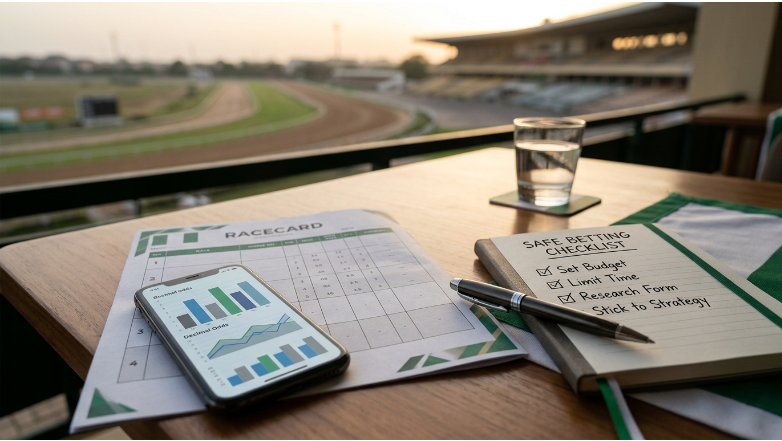
A racecard is the basic reference sheet for a race. It lists the declared runners and key facts about the event. At first glance it can look busy, especially if you’re more used to football line-ups, but the main fields become familiar quite quickly.
Here are the details you’ll commonly see.
- Race time and venue:Where and when the race is scheduled to take place.
- Race distance:The length of the contest, often shown in miles, furlongs or metres.
- Race type:Whether it is a flat race, hurdle, steeplechase or another format.
- Runners:The horses declared for the race, usually with numbered positions.
- Recent form:A short sequence representing previous finishing positions or outcomes.
- Weight:The amount assigned for a horse to carry in certain races, including the jockey and equipment.
- Draw:The starting stall position in races where stalls are used.
- Jockey and trainer:The rider and the person or team responsible for preparing the horse.
- Course-and-distance record:Whether a horse has previously competed successfully at that course and over that distance.
- Non-runners:Horses originally entered but withdrawn before the start.
Recent form is often the first thing people notice. For example, a string of numbers may show finishing positions from previous runs. Yet form alone leaves out plenty of context. Were those races over the same distance? On comparable ground? At the same level of competition? Was there a long gap between runs?
The draw can matter at some tracks and distances, particularly where the route to the first bend is short. But it is not a shortcut to knowing the result. A draw number is simply one information field among several.
The same goes for jockey and trainer statistics. They can be useful background, especially over a season, but racing is not a spreadsheet exercise with a guaranteed answer. Horses are living athletes, tracks change, starts vary and a race can unfold in unexpected ways.
If you’ve ever watched football statistics point one way only for a late substitution or deflection to change everything, you’ll understand the principle.
Odds: what the numbers actually mean
Odds are a market’s estimate of possible outcomes, not a prediction machine. They shift as new information appears and as people place bets.
For readers used to football coverage, decimal odds may be the most straightforward format. With decimal odds, the number includes the original stake in the total return calculation.
A neutral example:
- Odds of 00imply a total return of 2.00 units for every 1 unit staked if the selection is successful.
- Odds of 00imply a total return of 5.00 units for every 1 unit staked if successful.
To turn decimal odds into an approximate implied probability, divide 1 by the odds and multiply by 100.
- 00: 1 ÷ 2.00 = 50%
- 00: 1 ÷ 5.00 = 20%
That figure is not the true likelihood of an outcome. It is an estimate reflected in the market, and the market may also include an operator margin. In a race with many runners, the implied probabilities across the field can add up to more than 100 per cent for that reason.
Why markets move
Odds can move for several ordinary reasons:
- A non-runner changes the make-up of the race.
- The weather affects the racing surface.
- Fresh information emerges about a runner’s participation or conditions.
- A large volume of betting activity changes the market price.
Movement does not prove that someone knows the result. It simply shows that the price has changed. Treat it as information to note, not a signal to act on.
Checking information and operators carefully
Before using any betting service, take a slow and factual approach. Promotional wording should never replace reading the details yourself.
Use this checklist:
- Regulatory status:Check which authority regulates the service where you are located, and whether the activity is permitted in your Nigerian state or territory. Rules and enforcement can differ, so confirm current local requirements with the relevant official regulator before publication or use.
- Age-gating:The service should have clear age-verification processes. Betting is only for adults who meet the applicable legal age requirement.
- Terms and rules:Read settlement rules, withdrawal conditions, account restrictions and rules for abandoned or altered races.
- Payments:Look for clear explanations of deposit and withdrawal methods, processing times and any applicable charges.
- Privacy:Check how personal information is collected, stored and shared.
- Customer support:Find the support channels before opening an account. A visible help centre and accessible contact route matter.
- Market coverage:Check whether the service actually covers the race meetings and bet types you want to understand, without assuming every event is available.
- Responsible-play tools:Look for deposit limits, time-outs, self-exclusion options and account-history access.
Commercial resource: For readers comparing horse racing betting sites, review the available markets, rules, eligibility and responsible-play tools before deciding whether to use any service.
That is a resource link, not an endorsement. Availability, eligibility and regulatory status should always be checked independently.
Set boundaries before the first race
It’s easy to get absorbed in a busy race meeting, especially when races run close together. Clear boundaries help keep the activity in its proper place: optional entertainment, not a plan for income or a response to pressure.
A few sensible habits make a difference:
- Decide on a fixed entertainment amount before you begin, and do not exceed it.
- Keep a simple record of deposits, stakes and time spent.
- Never try to recover previous losses by increasing stakes.
- Take breaks between meetings or after a set period.
- Avoid betting when upset, tired, distracted or under pressure.
- Use account limits, time-outs or self-exclusion tools where they are available.
- Speak with someone you trust or seek professional support if betting no longer feels manageable.
The Gambling Commission’s support information is UK-focused, but its general message is useful anywhere: recognise concerns early and use support routes rather than dealing with them alone. For Nigeria-specific help, seek a reputable local health, counselling or regulatory support service.
Quick questions Nigerian sports readers often ask
What is the most useful part of a racecard?
There isn’t one magic field. Start with the race type, distance, conditions, runners and recent form. Then read the details as a whole rather than relying on one number.
Are shorter races easier to follow?
They are quicker, but not necessarily easier to interpret. A sprint can be decided by the start and early positioning, while a longer race raises different questions about pace and stamina.
Do lower odds mean a horse will win?
No. Lower odds usually mean the market gives that runner a stronger estimated chance than others, but every race retains uncertainty.
Where can I build broader sports knowledge?
If you follow Sports247.ng, use its football news coverage for team updates, fixture pages for schedules and results, and betting-literacy hub content for explanations of odds, markets and responsible participation. The same healthy habit applies across sports: read the information, question bold claims and keep perspective.
Horse racing becomes far more interesting once you understand its language. Read the racecard, know what the odds represent, respect the uncertainty and set your limits before anything begins. That’s a steadier way to follow the sport.