Nigeria Football Federation President Alhaji Ibrahim Musa Gusau, MON, has explained that his decision to resign from office was taken in the overriding interest of Nigerian football, insisting that stepping aside will provide the opportunity for a comprehensive reform of the country’s football administration.
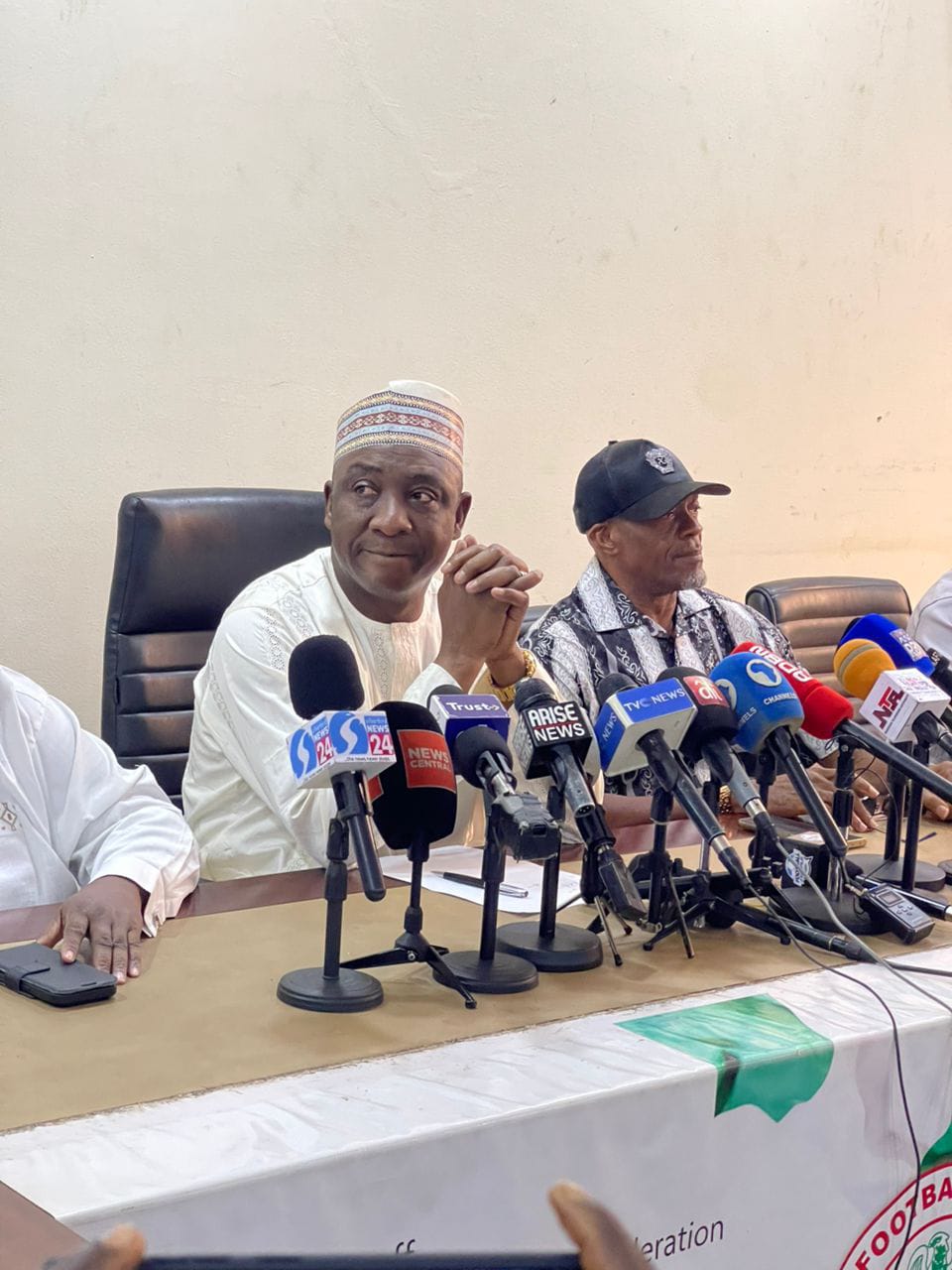
Gusau announced his resignation on Thursday at a World Press Conference held at the NFF Secretariat in Abuja, ending his three years and eleven months in office and bringing his tenure to a premature conclusion, just 34 days before the expiration of his four-year mandate.
The former NFF president said the decision was not taken suddenly, revealing that he had consulted extensively with his family, friends and stakeholders within the Nigerian football community before reaching the conclusion that resignation was the best option.
According to Gusau, he had also informed members of the NFF Executive Committee of his decision and encouraged them to consider their own positions, although he stressed that the decision ultimately belonged to each member.
“My resignation is intended to give way to a comprehensive and orderly reform process aimed at addressing the longstanding institutional, governance and developmental challenges confronting Nigerian football,” Gusau said.
Despite the circumstances surrounding his departure, Gusau insisted that he was leaving office with a sense of satisfaction over what his administration had been able to achieve since he was elected NFF president in Benin City, Edo State, on September 30, 2022.
“These three years and eleven months did not just come like that,” he said.
“At least we have something that we can tell Nigerians and the world that we have achieved for the little opportunity we had during this period.”
Gusau highlighted the revival of coaching education as one of the major achievements of his administration, noting that the NFF had organised courses across virtually all licence categories during his tenure.
He particularly pointed to the long-awaited CAF A Licence course, which he said would commence on September 13 after being absent from Nigeria for several years.
“The last one we are going to do is the CAF A Licence training, which has not been taking place for the past eight years, and that will commence on the 13th of September. Everything has been concluded about it,” Gusau said.
The outgoing NFF president also defended his administration’s record in domestic football, pointing to greater stability in the league calendar and insisting that Nigerian football had moved away from the uncertainty that previously surrounded the start and completion of league seasons.
“Before now, none of you as journalists could go anywhere and say this is when our league will start, or this is when our league will end,” he said.
Gusau also cited progress in refereeing, noting that Nigerian match officials had returned to prominent continental assignments, including semi-final appointments at major CAF competitions.
Infrastructure was another area he highlighted, with Gusau pointing to the 68-room players’ hostel and new training pitches at the MKO Abiola National Stadium as part of the projects initiated during his administration.
He also reflected on the performances of Nigeria’s national teams, identifying the Super Eagles’ silver and bronze medals at the last two Africa Cup of Nations tournaments as notable achievements, alongside the Super Falcons’ 2025 Women’s Africa Cup of Nations triumph in Morocco.
But Gusau acknowledged that his tenure also ended against the backdrop of some painful national-team disappointments.
The Super Falcons’ failure to qualify for the 2027 FIFA Women’s World Cup was the most damaging setback, ending Nigeria’s remarkable record of appearing at every edition of the tournament since its inception.
That disappointment followed the Super Eagles’ failure to qualify for the 2026 FIFA World Cup and the U-20 men’s team’s failure to secure qualification for the next Africa U-20 Cup of Nations.
Those results intensified calls for change and placed increasing pressure on the NFF leadership.
Gusau, however, chose to frame his resignation as an opportunity for Nigerian football to begin a new phase rather than simply as an admission of failure.
His decision, he said, was intended to create room for a properly structured reform process capable of confronting the deeper problems that have affected Nigerian football for years.
The resignation also brings to an end Gusau’s time as president of the NFF and president of WAFU Zone B, a position he held alongside his national football responsibilities.
As he prepares to leave the football house, Gusau’s final message was that his administration should be judged by both the challenges it faced and the foundations it believes it has laid.
And with his decision to step aside coming just 34 days before the end of his mandate, Gusau believes he is leaving Nigerian football with one final responsibility — to give the game the space and opportunity to begin the comprehensive reform he says it desperately needs.