
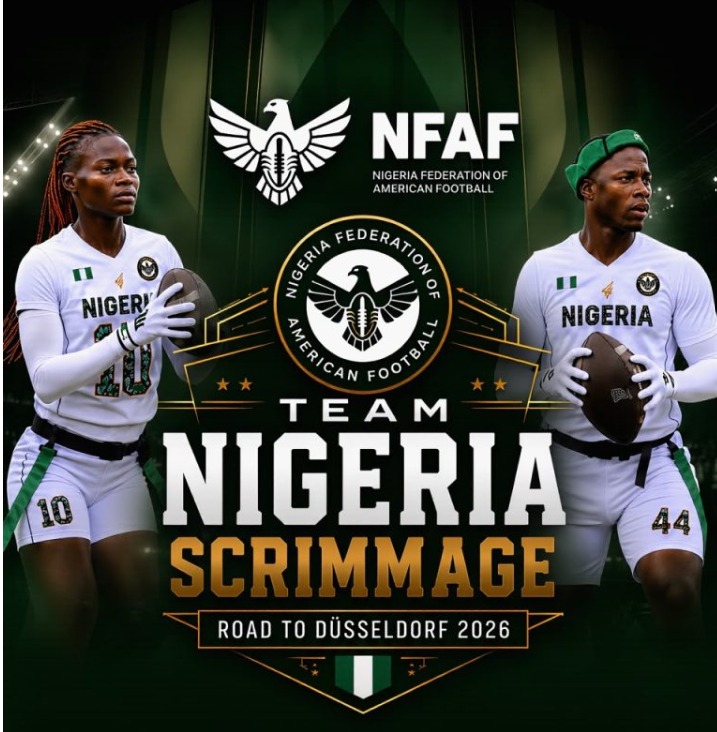
Nigeria’s much-anticipated debut on the world stage of flag football has ended in heartbreak, with the country’s men’s and women’s national teams officially withdrawn from the IFAF Flag Football World Championships Düsseldorf 2026 after the travelling delegation failed to secure the required German visas in time.
The withdrawal was confirmed in a joint statement issued by the International Federation of American Football (IFAF), Nigeria’s National Sports Commission (NSC) and the Nigeria Federation of American Football (NFAF).
The decision comes just days before the championships, scheduled for August 13–16 in Düsseldorf, where Nigeria was due to make its first appearance at the IFAF World Flag Football Championships.
A Dream That Turned Into a Visa Nightmare
The development is particularly painful because Nigeria earned its place in Düsseldorf by making history at the inaugural IFAF Africa Flag Football Championships in 2025, where the country captured both the men’s and women’s titles.
The Nigerian teams had therefore arrived at the threshold of a historic opportunity: to become the first Nigerian men’s and women’s flag football teams to compete at the world championship and showcase their talent on the international stage.
Instead, the teams will now watch the tournament from home.
According to the joint statement, IFAF, its event partners and the relevant authorities spent the past 10 days exploring possible solutions to get the Nigerian delegation to Germany.
But those efforts ultimately failed.
“Regrettably, all parties were informed this morning that the visas would not be issued in time for the Championships,” the statement said.
The news is also being reported internationally as a major blow to Nigeria’s historic qualification campaign.
No Replacement — Nigeria’s Opponents Get Automatic Wins
Because the withdrawal came so close to the tournament, IFAF said there is no longer enough time to replace Nigeria’s men’s and women’s teams with the respective reserve teams from the 2025 African championships.
Consequently, teams scheduled to face Nigeria in the group stage will receive automatic victories, in accordance with the competition regulations.
That means Nigeria’s absence will directly alter the competitive landscape of both the men’s and women’s competitions.
For the players and coaches who had spent months preparing for the biggest assignment of their careers, the consequences are devastating.
IFAF, the NSC and NFAF said their thoughts are “first and foremost” with the athletes and team staff who had earned their places as African champions and were preparing to represent Nigeria at their first world championship.
Olympic Dream Not Dead
Despite the devastating setback, Nigeria’s road to the Los Angeles 2028 Olympic Games has not been closed.
The joint statement makes clear that both Nigerian teams will still have an opportunity to compete at the 2027 IFAF Continental Championships.
A top-two finish there would secure qualification for the Olympic Q-Series, the final stage of the qualification process for LA28.
That gives Nigeria another opportunity to fight for a place at the historic Olympic debut of flag football.
But the Düsseldorf setback will undoubtedly be remembered as a painful missed opportunity.
From African Champions to World Championship Withdrawal
The contrast could hardly be more dramatic.
Nigeria entered the 2026 international season as Africa’s first men’s and women’s flag football champions, having conquered the continent in Egypt.
The country’s performances had created enormous expectations for its first appearance at the world championships.
Now, instead of seeing Nigeria’s green and white jerseys on the fields in Düsseldorf, spectators will see the teams’ opponents awarded automatic victories.
The setback also means Nigeria will not have the opportunity to test itself against the world’s best at a championship that forms an important part of flag football’s journey towards its Olympic debut.
The 2026 IFAF World Championships are scheduled to take place in Düsseldorf from August 13 to 16, with the United States entering as defending champions.
A Painful Lesson for Nigerian Flag Football
The withdrawal raises difficult questions about international sports administration, travel planning and the systems required to move athletes from continental qualification to the world stage.
For Nigerian flag football, the immediate priority will now be ensuring that the disappointment does not derail the country’s longer-term Olympic ambitions.
The joint statement from IFAF, the NSC and NFAF stressed that the three organisations remain committed to the continued development of flag football in Nigeria and across Africa.
For the athletes who had dreamed of making history in Düsseldorf, however, that assurance cannot erase the immediate disappointment.
Nigeria won Africa. It earned its place among the world’s best. But a visa crisis has now denied the country’s men and women the chance to prove themselves on the biggest flag football stage before the Olympic Games.