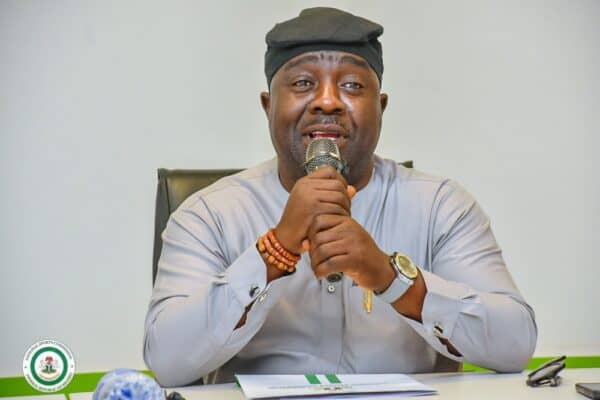
Director-General of the National Sports Commission (NSC), Hon. Bukola Olopade, has reaffirmed his administration’s commitment to transforming Nigerian domestic football, insisting that the 2026/27 Nigeria Premier Football League (NPFL) season will commence regardless of how many clubs are ready to comply with the Commission’s reform agenda.
READ ALSO: Bukola Olopade Draws The Line: ‘Clubs That Can’t Meet New Standards Should Step Aside’
Speaking amid growing discussions surrounding the proposed changes, Olopade maintained that the reforms are not designed to create conflict but to reposition Nigerian football for long-term growth, professionalism, and commercial success.
Sports247 reports that the NSC boss dismissed suggestions that the reforms amount to a confrontation with club owners, stressing instead that they represent a collective effort to rescue the nation’s football from years of administrative shortcomings.
“It is not a war; it is a call for collaboration and for the improvement that is much needed in our football. We are all a family, and if we keep deceiving one another that all is good, we only have ourselves to blame. We must reform the league and our football in the final analysis,” Olopade stated.
The NSC Director-General argued that the financial opportunities available to Nigerian football remain enormous but largely untapped because investors require a professionally managed league before committing significant resources.
He pointed to the Commission’s recent success in attracting private-sector funding for other sporting events as evidence that football can generate far greater commercial value if properly administered.
“The fact is, the money is out there and investors are eagerly waiting for a properly run league and sports administration. If the National Sports Festival in 2025 raised up to ₦5 billion, and Enugu 2026 has already generated more than ₦7 billion and is still counting, while road races and the National Intermediate Games continue attracting billions from the private sector, why should the most beautiful sport in the world struggle to raise ₦10 billion annually?”
According to Olopade, the answer lies in the urgent need for structural reforms across Nigerian football, beginning with the domestic leagues.
He therefore challenged club owners to embrace the new direction, insisting that genuine progress can only be achieved through collective responsibility.
“We have to wake up and smell the morning coffee. The club owners must own these reforms if they truly want our football leagues, especially the NPFL, to move away from mediocrity.”
The proposed reforms are expected to focus on improved governance, stricter club licensing, enhanced player welfare, financial accountability, and stronger commercial structures as the NSC seeks to reposition the NPFL as a more competitive and attractive league on the African football landscape.






, Hon. Bukola Olopade, has reaffirmed his administration's commitment to transforming)