
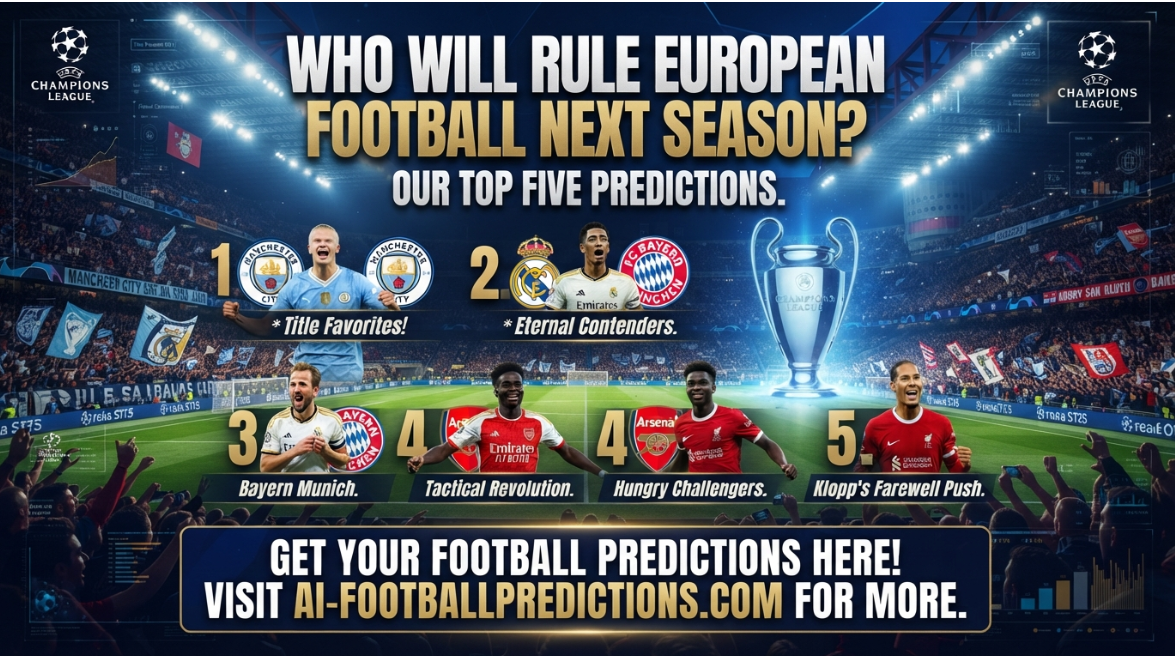
Every new football season begins with a familiar debate: which club will emerge as the strongest force in Europe?
The answer is rarely determined by reputation alone. A successful campaign depends on squad depth, recruitment, tactical decisions, player availability, and the ability to perform under pressure when the biggest trophies are at stake.
For bettors, predicting the next European champion is an opportunity to look beyond the obvious favorites. The strongest team on paper is not always the best betting selection, particularly when short odds fail to reflect the risks of competing across multiple competitions.
With that in mind, here are five potential profiles of clubs that could dominate European football next season, along with the factors that could influence their chances.
1. The Proven European Giant
The most natural candidate is a club that already understands how to win at the highest level.
European experience can be a major advantage, particularly during the knockout stages of the Champions League. Players who have previously competed in quarter-finals, semi-finals, and finals are often better prepared for the pressure of decisive matches.
However, established success can also create challenges.
A team that has won major trophies may face increased expectations, while opponents become more motivated to defeat them. The ability to maintain hunger and consistency is therefore essential.
Bettors using AI Football Predictions Today can consider AI football predictions and current statistical trends as part of their research. However, any forecast should also account for injuries, squad changes, fixture congestion, and the quality of upcoming opponents.
2. The Club That Gets Recruitment Right
The summer transfer window can completely change the outlook for a European contender.
A team that identifies weaknesses and addresses them with carefully selected signings could make a significant improvement.
The key is not necessarily the number of transfers. One or two players who perfectly fit a manager’s tactical approach can sometimes have a greater impact than several expensive additions.
Bettors should examine how new signings could influence the team’s overall balance.
A club that adds defensive stability, midfield creativity, or attacking depth may become much stronger than its previous results suggest.
However, new players may also require time to adapt. This makes early-season football predictions particularly difficult, as a team’s long-term potential may not immediately translate into consistent performances.
3. The Emerging European Challenger
Every season brings at least one club that appears ready to take the next step.
This could be a team that has already established itself as a domestic title contender but has struggled to make an impact in Europe.
The transition from domestic success to Champions League dominance is challenging.
European competition requires teams to handle different tactical styles, long away trips, and intense knockout pressure.
Still, a young squad with strong development potential can become increasingly dangerous with every campaign.
From a betting perspective, these emerging challengers can be particularly interesting because the market may underestimate their potential until they achieve a major European breakthrough.
4. The Tactical Innovator
Modern football is increasingly influenced by tactical innovation.
A manager who finds a way to exploit weaknesses in established systems can quickly transform a team’s competitive position.
The most promising tactical contenders are those capable of adapting their approach.
They may dominate possession against weaker opposition but rely on fast transitions against elite teams. They may press aggressively in one match and defend compactly in another.
This flexibility can be extremely valuable in European competition.
For football betting predictions, bettors should consider how a team’s playing style matches up against potential Champions League opponents.
A club with an excellent domestic record may struggle against specific tactical systems, while another team with fewer league points could be better equipped to handle European competition.
5. The Dark Horse Nobody Is Talking About
The fifth candidate is the unpredictable outsider.
European football regularly produces unexpected stories. A team with limited expectations can eliminate a major favorite and suddenly find itself competing for a place in the final.
Dark horses are attractive to bettors because their odds can offer greater potential value.
However, identifying a genuine contender requires more than finding a club with one impressive result.
The ideal dark horse should have strong underlying statistics, a balanced squad, reliable defensive organization, and enough depth to survive multiple rounds.
A single upset can be achieved through luck or momentum. Winning a major European trophy requires sustained quality.
What Could Separate the Winner From the Rest?
The next European champion will need to overcome several challenges.
Fixture congestion could become a major factor, particularly for teams competing in multiple competitions.
Injuries can also change the balance of power. Losing one key player may be manageable, but several absences at the same time can expose weaknesses in squad depth.
Managerial decisions will matter as well.
The ability to rotate players without significantly reducing performance could prove decisive during the final months of the campaign.
Bettors should therefore consider not only a club’s strongest starting lineup but also the quality of its substitutes.
The Road to European Glory Starts Before the First Kick
Predicting the dominant club in European football is never straightforward.
The strongest candidate may be an established giant with years of experience, but an ambitious challenger could emerge after a successful transfer window or tactical transformation.
For bettors, the most effective approach is to compare multiple factors rather than relying on reputation.
Current form, expected goals, squad depth, transfer activity, tactical flexibility, player availability, and European experience can all influence a club’s probability of success.
The team that eventually lifts the trophy may not be the one that attracts the most attention before the season begins.
That is what makes long-term football predictions so fascinating.
The next European champion could be a familiar powerhouse, a rapidly developing challenger, or a dark horse that nobody expects to go all the way. Whatever happens, the race for continental dominance will be shaped by the decisions made before the season even begins.
The clubs that recruit intelligently, manage their squads effectively, and adapt to the pressure of elite competition will have the best chance of ruling Europe.
And for football bettors, the challenge is to identify those qualities before the rest of the market catches up.