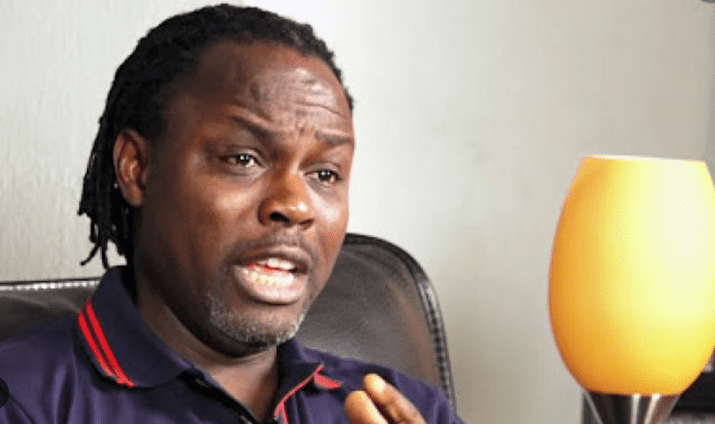
Former Super Eagles forward Victor Ikpeba has defended former Nigeria Football Federation president Ibrahim Musa Gusau following his resignation, insisting that it would be unfair to blame the former football administrator for every problem confronting Nigerian football.
Ikpeba said while Nigerian football undoubtedly has serious issues that require urgent attention, the successes and failures of the game cannot be attributed to one individual, arguing that football administration is a collective responsibility involving administrators, coaches, players and other stakeholders.
“Nigerian football has its issues, but it is unfair to put all the blame on Gusau,” Ikpeba said.
The former Monaco and Borussia Dortmund forward was reacting to Gusau’s decision to step down from the NFF presidency after three years and eleven months in office.
Gusau announced his resignation during a World Press Conference at the NFF Secretariat in Abuja, saying he had decided after consultations with his family, friends and stakeholders and in the overriding interest of Nigerian football.
“My resignation is intended to give way to a comprehensive and orderly reform process aimed at addressing the longstanding institutional, governance and developmental challenges confronting Nigerian football,” Gusau said.
For Ikpeba, however, the former NFF president should not be made the sole scapegoat for Nigeria’s recent disappointments.
“The success and failure of football anywhere in the world is a collective situation,” Ikpeba said.
His intervention comes after mounting criticism of Gusau’s administration following a difficult period for Nigeria’s national teams.
The Super Eagles failed to qualify for the 2026 FIFA World Cup, while the Super Falcons suffered the historic setback of missing the 2027 FIFA Women’s World Cup — their first absence from the competition since the tournament began in 1991.
Those failures triggered intense calls for the NFF leadership to resign, with former internationals and football stakeholders arguing that a new direction was needed.
Gusau eventually stepped aside, alongside General Secretary Mohammed Sanusi and members of the NFF Executive Committee, opening the door to a broader reform process.
Ikpeba, however, believes the resignation should not be interpreted as proof that everything that went wrong during the period was the responsibility of the former NFF president.
The former African Footballer of the Year argued that coaches, players, administrators, clubs and other stakeholders all contribute to the performance of Nigerian football.
He believes the country should therefore resist the temptation to reduce its football problems to the actions of one person.
“It was unfair to have put all of the faults on the former NFF president,” Ikpeba added.
Gusau himself used his final address to highlight what he considered achievements during his tenure, including renewed coaching education, improvements in the domestic league calendar, progress in refereeing and infrastructure development.
He also pointed to the Super Eagles’ silver and bronze medals at recent Africa Cup of Nations tournaments and the Super Falcons’ 2025 Women’s Africa Cup of Nations triumph in Morocco.
The outgoing NFF president also revealed details of a new Adidas kit sponsorship agreement which he said would provide the federation with significantly more financial value than its previous deal with Nike.
But Ikpeba’s argument is that even with those achievements and shortcomings, the country’s football problems are too deep and complex to be placed entirely on Gusau.
The former Super Eagles star believes the current reform process should therefore focus on fixing the system rather than simply finding individuals to blame.
That view comes at a critical moment, with the National Sports Commission now leading discussions on the restructuring of Nigerian football following the mass resignations at the NFF.
NSC Chairman Shehu Dikko has already said that the time has come for “a new look” in the way football is administered in Nigeria, while several stakeholders have called for changes to the NFF statutes, electoral structure and wider governance system.
Ikpeba believes those reforms should be used to create a system in which responsibility is properly shared and accountability is clearly defined.
For the former Super Eagles star, Gusau’s departure should therefore not close the conversation about Nigerian football.
Instead, it should open a more honest one — one that recognises the failures but also acknowledges that Nigeria’s football problems were never the responsibility of one man alone.