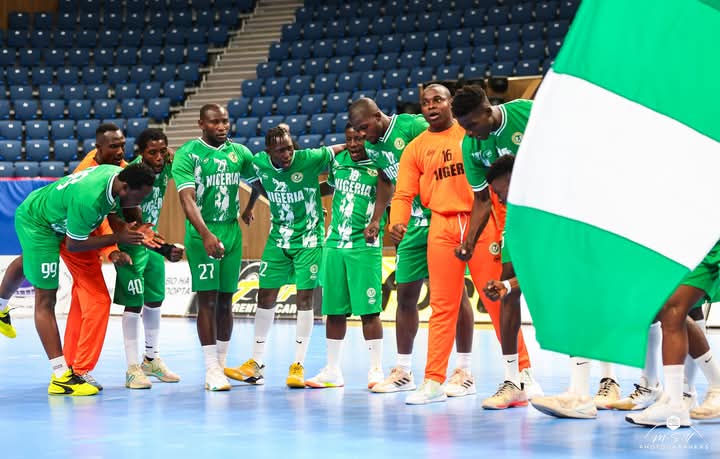

Nigeria’s Senior Men’s National Handball Team, the Golden Arrows, have drawn a clear line in the sand as they opened camp in Abuja ahead of the 2026 Africa Men’s Handball Nations Cup in Kigali, Rwanda. This is not just another continental outing; it’s a high-stakes mission with direct qualification for the 2027 World Men’s Handball Championship firmly on the table.
The championship, scheduled for January 21–31, 2026, doubles as Africa’s World Championship qualifier, with only the top five teams earning automatic tickets. For Nigeria, the margin for error is slim, and preparations have started early to ensure nothing is left to chance.
READ ALSO: Ademola Lookman Hails Osimhen On Super Eagles’ Top Scorer’s 27th Birthday
Seventeen of the 24 invited players are already grinding it out at the Indoor Sports Hall, Package B of the MKO Abiola National Stadium, Abuja. Training sessions have been intense and business-like, centred on tactical execution, physical conditioning, and team chemistry. The remaining invitees have been given a firm deadline to report by Tuesday, following a directive approved by Handball Federation of Nigeria (HFN) President, Mr Jibril Saidu Ojih (FNSQ). Fail to show up, and you’re out. No sentiment, just standards.
Nigeria has been drawn into a tough Group B alongside hosts Rwanda, seven-time African champions Algeria, and Zambia. It’s a group designed to punish complacency, and the technical crew knows it. Head Coach Rafiu Salami, assisted by Innocent Nwankwo Chukwuma and Emmanuel David, has made tactical discipline and mental readiness the non-negotiables of camp life.
The invited squad reflects a deliberate strategy by the HFN: blend domestic grit with international exposure. European-based back-right Farouk Yusuf (France) headlines the foreign contingent, joined by Morocco-based Rotimi Gbenga and Akeem Salami, as well as Turkey-based pivot Daniel Bello. Their experience is expected to add composure and game intelligence at critical moments.
Between the posts, competition is fierce. Qatar-based goalkeeper Olatunde Adams leads a solid unit that includes Michael Ogbaji and Mohammed Abbas from Cotonou, Benin Republic, and Okwor Obinna of COAS Shooters. It’s depth with intent, not just numbers.
Across the court, Nigeria boasts a well-balanced roster. The backcourt features dependable options like John Shagari, Nasiru Hassan, and Mohammed Adam, while the centre-back role is reinforced by Ibrahim Dikko and Farouk Kazeem. The pivot and wing positions are stacked with energy and firepower, with players such as Sessugh Stephen, James Korede Kuti, Ibrahim Adio, and a speedy wing crew led by Anas Mohammed, Kareem Ajibike, Mustapha Mohammed, and Abubakar Ahmed.
Nigeria has appeared at the Africa Handball Nations Cup 15 times since debuting in 1974, with a best finish of fourth place in 1998. That history is respected—but not romanticised. This camp signals a shift toward results-driven preparation, accountability, and global ambition.
Bottom line: the Golden Arrows are not in camp to make up the numbers. They are here to compete, to qualify, and to reassert Nigeria’s relevance on the African handball map. Kigali will demand clarity, courage, and cohesion. Abuja is where that work begins.