

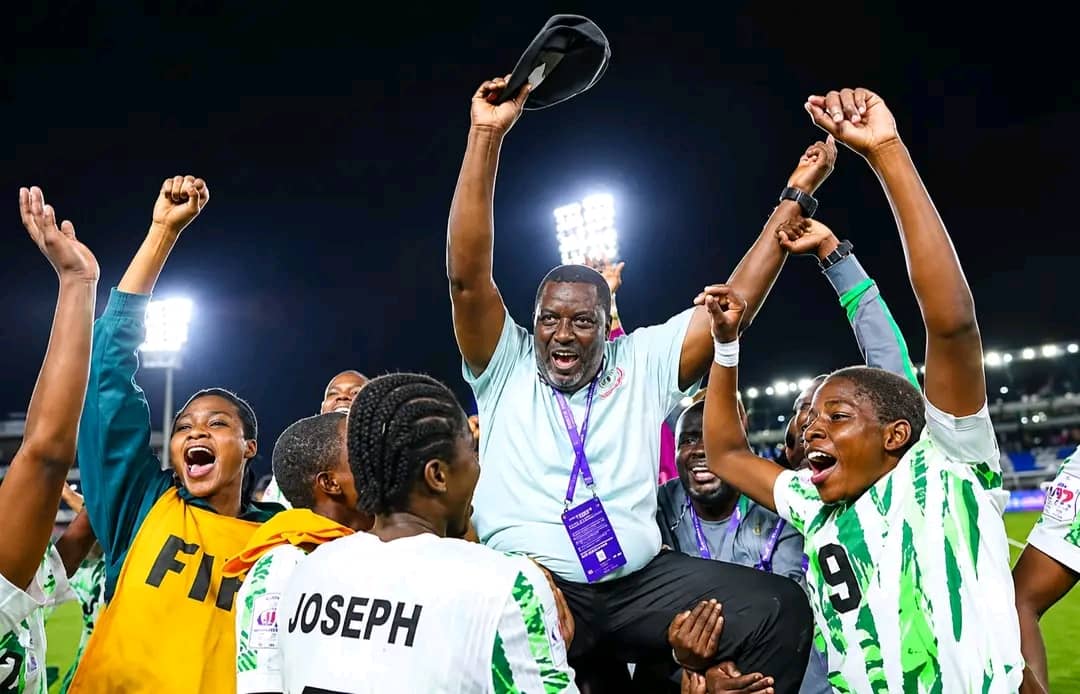
Nigeria U-17 women’s national team head coach Akeem Busari has provided an insight into the tactical decisions, discipline and determination that inspired the Flamingos to their historic triumph at the FIFA U-17 Women’s World Cup in Morocco.
Speaking in a post-match interview following Nigeria’s successful campaign, Busari explained how his technical crew identified Japan’s attacking patterns and developed a strategy to limit their strengths during the final.
According to the coach, Japan frequently targeted specific areas of the pitch with long balls, hoping to win second balls and exploit spaces behind the opposition’s defensive line, Sports247 gathered.
“We identified that whenever they played long balls into a particular zone, their intention was to win the second ball and attack the space behind our back four,” Busari explained.
He revealed that Nigeria adjusted their distribution from the defensive half, avoiding the areas Japan wanted to exploit while targeting available spaces instead.
Sports247 reports that Busari also acknowledged Japan’s speed, resilience and ability to maintain attacking pressure, describing the final as a tactical contest in which both teams continually sought to outmanoeuvre each other.
After Nigeria took the lead, the coaching crew focused on managing the game, protecting their advantage and maintaining defensive organisation. However, Japan’s equaliser from a set-piece situation forced another adjustment.
The Flamingos responded by prioritising collective defending, managing the tempo and looking for opportunities to score again.
Busari identified dedication, determination and discipline as the three fundamental principles behind Nigeria’s approach.
He explained that the team had to remain compact, recognise pressing triggers and alternate between a mid-block and high press depending on Japan’s build-up structure.
The strategy also involved using Nigeria’s physical strength and pressing ability to force inaccurate passes, win second balls and transition quickly into attack.
“We had to play to our strengths rather than allow the opposition to dictate the game according to theirs,” he said, stressing that Nigeria were determined not to allow Japan’s pace to dominate the contest.
Beyond the final, Busari described the tournament as evidence of the growing quality of African women’s football. He noted that the competitiveness of Nigeria’s group, which included the defending champions, demonstrated the continent’s improving standard.
He expressed confidence that more African nations would progress beyond the knockout stages and challenge for major honours in future editions.
The Flamingos coach concluded by appreciating the Federal Government, National Sports Commission, Nigeria Football Federation, Nigerian supporters in Morocco and Egypt, and fans from other African countries who continued to support the team after their own nations were eliminated.
He particularly acknowledged supporters from Ghana, Kenya and Zambia for their encouragement, prayers and messages throughout the competition.
Busari ended with a heartfelt message of appreciation: “We will still meet in peace and not in pieces.”