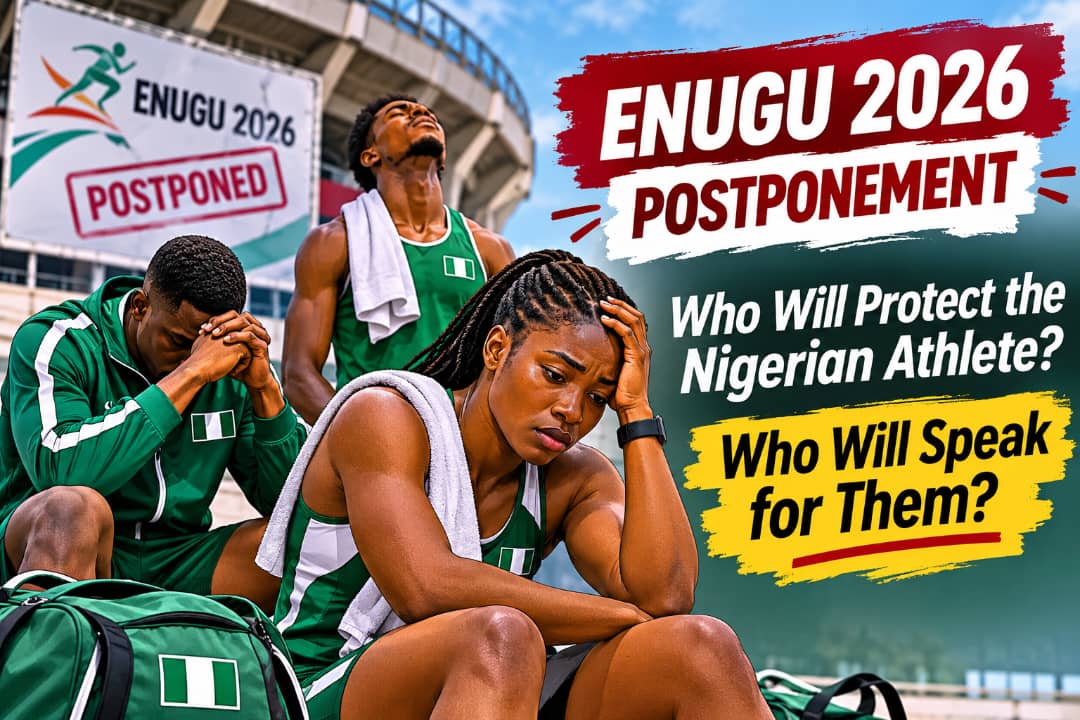
Behind every postponed sporting competition are shattered expectations, disrupted preparations, financial sacrifices and athletes whose dreams have once again been put on hold.
The postponement of the 23rd National Sports Festival, tagged Enugu 2026 Coal City Games, until May 2027 has brought to the fore a fundamental question that Nigerian sports administrators must confront: Who will protect the Nigerian athlete, and who will speak on their behalf when decisions affecting their careers are made?
Across social media, athletes have been expressing their disappointment and frustration. For many, the emotional pain goes beyond missing a competition. It is about months of sacrifice, years of preparation and personal ambitions suddenly thrown into uncertainty.
On November 18, the National Sports Commission (NSC) approved the Enugu State Government’s request to postpone the festival, originally scheduled for November 28 to December 12, 2026, citing concerns over the readiness of the Nnamdi Azikiwe Stadium and Awgu Games Village.
Just 10 days to the opening ceremony, athletes were told they would have to wait another six months.
It is even more disturbing considering that weeks before the postponement, the NSC had repeatedly assured stakeholders that the festival would go ahead as scheduled.
While the authorities have explained the infrastructural challenges responsible for the decision, where exactly does the Nigerian athlete feature in these conversations?
Another disturbing development is the reported haste with which some state sports administrators called their athletes into camp upon receiving indications that the festival might be postponed.
Why the sudden desperation to commence camping when the possibility of postponement was already looming? Why were such arrangements not made much earlier to give athletes adequate time to prepare?
These developments raise uncomfortable questions about the priorities of some sports administrators and whether the welfare of athletes is genuinely at the centre of their decisions or whether financial considerations have taken precedence.
In states where governments had already released funds for camping, logistics, allowances and other preparations, the postponement creates an additional accountability challenge.
What happens to the money already released? How much was actually spent on the athletes? Will the unspent funds be accounted for? Will fresh financial requests be submitted when preparations resume ahead of May 2027?
The postponement was certainly not the fault of the state sports administrators. However, that does not absolve them of their responsibility to account for public funds entrusted to them for the preparation of athletes.
There is a danger that repeated postponements could become financially advantageous to some administrators while leaving the athletes themselves financially disadvantaged.
Another postponement could mean another budget, another round of approvals, another release of funds and another opportunity for administrative expenditure. Yet the athlete, for whom these funds are supposedly intended, may continue to struggle with feeding, transportation, training equipment and basic welfare.
The postponement of a sporting competition must never become a financial opportunity for administrators at the expense of the athletes.
For many athletes, particularly those in lesser-funded sports, the biennial National Sports Festival represents one of their few meaningful opportunities to compete, earn recognition, attract sponsorship, secure employment and potentially receive financial rewards through medal-winning performances.
Some may have borrowed money to prepare. Others may have sacrificed educational opportunities, employment commitments and family responsibilities to remain in peak competitive condition.
For an athlete who has structured an entire year around the festival, a postponement is not simply a change of date.
Athletes prepare their bodies to peak at specific periods. They endure demanding training sessions, manage injuries, maintain strict diets and make considerable personal sacrifices in anticipation of competition.
Who will bear the additional cost of another six months of preparation?
Coming at a time when the year is drawing to a close and the festive season is approaching, the postponement could also have serious financial implications for athletes who had hoped to return home with medal bonuses, allowances and other incentives.
How many had made commitments to their families based on these expectations? How many were hoping that their performances in Enugu would provide the breakthrough they desperately needed?
Unfortunately, this is not an isolated incident.
The previous National Sports Festival, the Gateway Games in Ogun State, suffered multiple postponements before eventually taking place in May 2025.
The maiden National Intermediate Games, initially scheduled to take place in Lagos in 2026, have also been moved to 2027.
The recurring disruption of Nigeria’s sporting calendar raises serious concerns about institutional planning, financial accountability and the protection of athletes’ interests.
The Enugu State Government has apologised, while the NSC has described the development as regrettable and promised a better-organised festival in May 2027.
But beyond apologies and assurances, what concrete measures are being put in place to cushion the impact on athletes?
Will there be additional training allowances? Will state governments continue to support their athletes throughout the extended preparation period? Will there be alternative competitions to help them maintain competitive fitness?
Were athletes’ representatives consulted before the decision was finalised?
Will state governments demand a comprehensive account of the funds already released to their respective sports councils and commissions for the postponed festival?
These are questions that deserve answers.
State governors must take a particular interest in how funds approved for sporting competitions are utilised. It is not enough to release money to sports administrators without establishing mechanisms to ensure that the intended beneficiaries actually receive the necessary support.
Athletes must not become mere instruments through which budgets are justified, funds are accessed and administrative expenses are approved, only to be abandoned when competitions are postponed.
The National Sports Commission, state sports councils, sports federations, athletes’ representatives and other relevant stakeholders must begin to treat athlete welfare as a central component of sports administration, rather than an afterthought.
Nigeria cannot continue to demand excellence from its athletes while failing to provide them with a predictable environment in which to pursue their careers.
There must be stronger systems of accountability, enforceable hosting timelines, contingency plans, transparent financial management and meaningful athlete representation in decisions involving major sporting competitions.
Sports administrators must also recognise that their positions exist because of the athletes, not the other way around.
Without athletes, there would be no National Sports Festival, no medals to celebrate, no delegations to lead and no sporting achievements for administrators to showcase.
The success of a National Sports Festival should not be measured solely by the quality of its stadiums, the grandeur of its opening ceremony or the number of medals won.
It must also be measured by how well the athletes, who are the very reason for its existence, are treated.
Stadiums can be completed. Facilities can be renovated. Competitions can be rescheduled. Administrative budgets can be renewed.
But the competitive lifespan of an athlete cannot be extended indefinitely.
Administrators may continue to occupy their offices and receive their salaries regardless of how many times a competition is postponed. For the athlete, however, every lost competitive opportunity could represent a significant setback in a career that has a limited lifespan.
Until the welfare, dignity and interests of Nigerian athletes become non-negotiable priorities, the same question will continue to demand an answer:
Who will protect the Nigerian athlete, who will speak on their behalf, and who will ensure that their dreams are no longer sacrificed on the altar of administrative shortcomings and financial interests?