
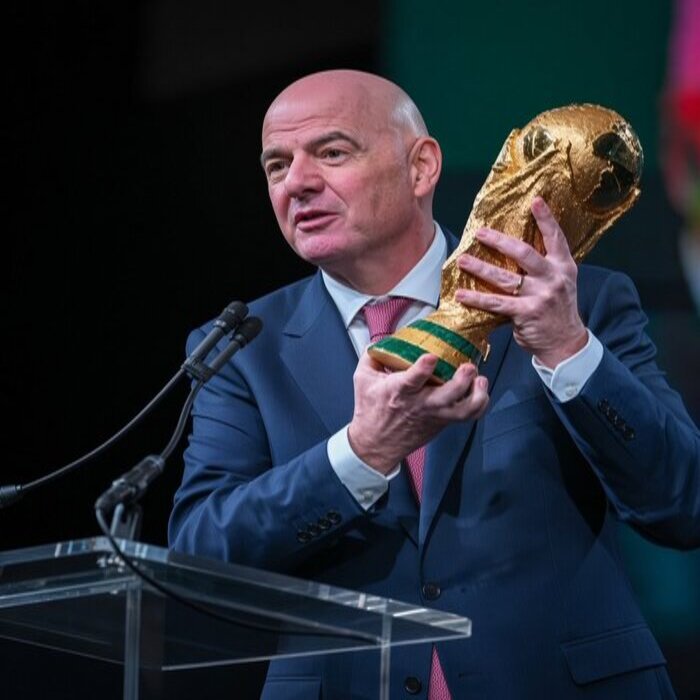
FIFA President Gianni Infantino has opened the door to the possibility of Nigeria hosting the FIFA World Cup in the future, expressing confidence in the country’s resources, football passion, and enormous potential to stage the world’s biggest football tournament, Sports247.ng reports.
Speaking in Abuja, the FIFA president acknowledged Nigeria’s standing as one of Africa’s leading football nations, maintaining that the country possesses the potential to become a destination for major international football competitions.
Infantino, however, explained that hosting a tournament of such magnitude would require substantial investment in infrastructure beyond the construction and renovation of football stadiums.
The FIFA president identified hotels, airports, transportation networks and other essential facilities as critical components that must be developed to accommodate the millions of visitors associated with a World Cup.
He expressed encouragement over ongoing infrastructure development in Nigeria, particularly projects in Abuja and Warri, describing such investments as positive steps towards strengthening the country’s capacity to host international sporting events.
Rather than immediately pursuing the senior FIFA World Cup, Infantino suggested that Nigeria could adopt a gradual approach by hosting smaller international competitions and building the necessary experience and infrastructure to accommodate bigger tournaments.
Such an approach would provide Nigeria with opportunities to demonstrate its organisational capabilities while addressing infrastructural challenges and meeting FIFA’s hosting requirements.
Nigeria is no stranger to organising international football competitions, having previously hosted the 1999 FIFA World Youth Championship and the 2009 FIFA U-17 World Cup.
However, hosting the senior World Cup would represent an entirely different challenge, requiring extensive collaboration between government authorities, football administrators, private investors and other stakeholders.
Infantino’s assessment offers encouragement to Nigerian football enthusiasts who have long dreamed of seeing the world’s biggest football stars compete on Nigerian soil.
His remarks also highlight the broader economic and developmental opportunities associated with hosting major sporting events, particularly in tourism, hospitality, transportation and employment.
While Nigeria has yet to secure a formal commitment from FIFA regarding a future World Cup, Infantino’s optimism suggests that the ambition should not be considered beyond the country’s reach.
For Nigeria, the challenge now is to transform its extraordinary passion for football into sustained infrastructural development capable of turning a long-held national dream into reality.