
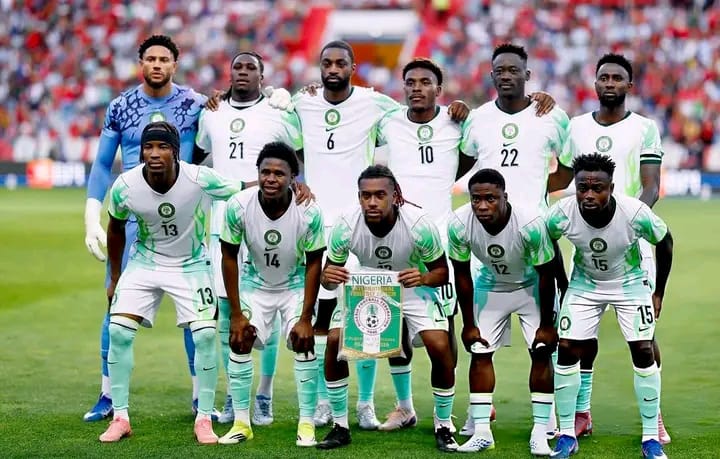
For decades, Nigeria’s Super Eagles stood as the benchmark of African excellence at the FIFA World Cup.
Their memorable performances, giant-killing exploits, and consistent appearances on football’s biggest stage earned them a reputation as one of Africa’s most successful national teams.
However, back-to-back failures to qualify for the 2022 and 2026 FIFA World Cups are gradually diminishing that legacy, while traditional rivals Ghana and continental powerhouse Morocco are rapidly closing the gap and setting new records.
Nigeria made its World Cup debut at the 1994 tournament in the United States and immediately announced its arrival by reaching the Round of 16.
The Super Eagles repeated the feat in France 1998 and again in Brazil 2014, establishing themselves as one of Africa’s most consistent representatives.
Over six World Cup appearances, Nigeria accumulated 21 matches, six victories, and 23 goals, becoming Africa’s highest-scoring nation at the tournament while also holding the continental record for the most World Cup wins.
For years, these achievements placed Nigeria comfortably ahead of other African nations. However, football history rarely stands still.
Nations that continue to qualify and compete naturally create opportunities to improve their records, while absent teams watch their achievements become increasingly vulnerable.
The consequences of Nigeria’s absence from consecutive World Cups are now becoming evident. Ghana’s dramatic 1-0 victory over Panama at the 2026 FIFA World Cup moved the Black Stars level with Nigeria’s record of six World Cup victories.
Remarkably, Ghana achieved the feat in just 16 matches compared to Nigeria’s 21, highlighting the efficiency of the four-time African champions on football’s biggest stage.
Morocco also poses a significant threat to Nigeria’s historical standing.
The Atlas Lions already own Africa’s greatest World Cup achievement after reaching the semi-finals in Qatar 2022, becoming the first African nation to reach the last four of the tournament.
With five World Cup victories entering the 2026 competition, Morocco is within touching distance of surpassing Nigeria’s record and further strengthening its position as Africa’s modern standard-bearer.
Even Senegal, despite having fewer appearances, boasts one of the continent’s best World Cup win ratios.
Their impressive performances since their debut in 2002 demonstrate how rapidly football hierarchies can change when countries consistently qualify and compete.
Nigeria’s decline in World Cup relevance is not solely about statistics. It also reflects the loss of visibility, influence, and prestige that accompany participation in the tournament.
A new generation of football fans is growing up watching Morocco make history, Ghana equal records, and other African nations compete against the world’s elite, while the Super Eagles remain spectators.
The two consecutive qualification failures have also interrupted Nigeria’s opportunity to build upon its rich World Cup history.
Every missed tournament means fewer chances to add victories, score goals, create memorable moments, and inspire future generations. In contrast, rival nations continue to strengthen their legacies with every appearance.
Despite the current situation, Nigeria still possesses the talent, football culture, and passionate support base needed to reclaim its place among Africa’s elite.
The Super Eagles remain one of the continent’s most recognizable brands and continue to produce players who excel in Europe’s top leagues.
However, history rewards those who remain active.
As Ghana draws level with Nigeria’s World Cup wins record and Morocco moves closer to establishing new continental milestones, the warning signs are clear.
Unless the Super Eagles return to the World Cup and begin rebuilding their international credentials, a legacy once considered untouchable could gradually become a chapter of the past rather than a benchmark for the future.
The race for African football supremacy is evolving, and Nigeria can no longer rely solely on historical achievements.
To preserve its World Cup legacy, the Super Eagles must once again earn their place on the global stage and compete where football history is written.