


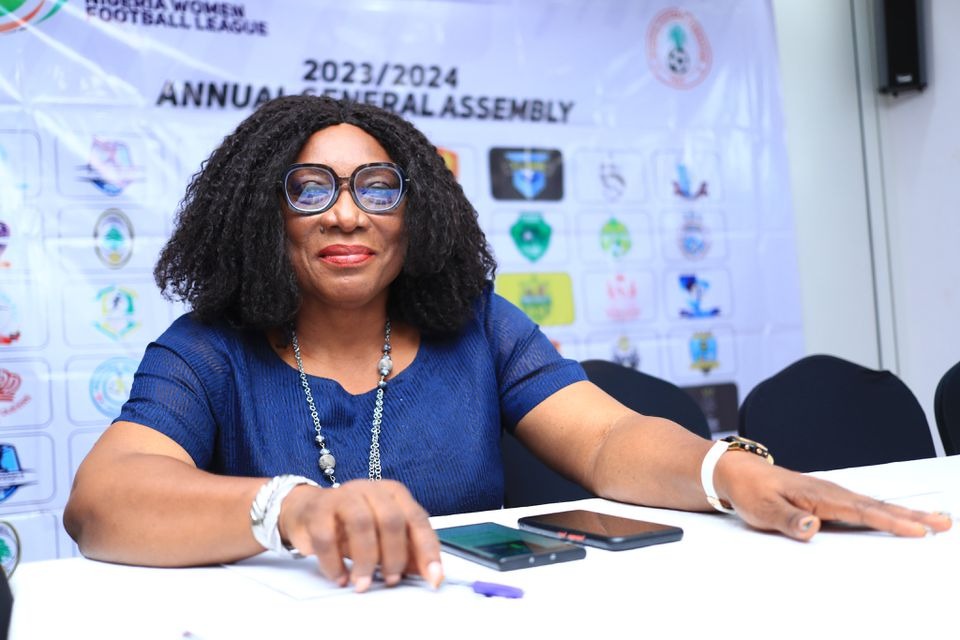
In a landmark memo addressed to the President of the Nigeria Football Federation (NFF), the Chairperson of the Nigeria Women Football League (NWFL), Nkechi Obi, has officially confirmed the expiration of the current NWFL Board’s two-year tenure, reflecting on a groundbreaking term that has transformed the landscape of women’s football in Nigeria.
In what is believed to be the first time in the country’s history, a board—upon the expiration of its tenure—has formally acknowledged the end of its service and presented a comprehensive account of its stewardship in such a structured and transparent manner.
Read Also: WAFCON 2025: Super Falcons Will Emerge Champions Without Dropping Any Point – Stella Mbachu
Obi’s tenure, which began following the board’s inauguration in mid-2023, is widely regarded as one of the most impactful in the NWFL’s 33-year history. In her memo dated June 30, 2025, she highlighted a string of achievements that have reshaped the structure, visibility, and financial footing of the women’s game in the country.
Unprecedented Growth Across the Leagues
Under her leadership, the NWFL expanded the number of clubs in the top-tier Premiership League from 14 to 20, effective from the 2025/2026 season, while the second-tier Championship League doubled from 12 to 20 clubs. In a further show of grassroots commitment, the Nationwide League was restructured into a States League, expected to kick off in August 2025 with over 150 participating teams across 30 states.
“This came about due to the advocacy work we undertook through our ‘Women’s Football Rising’ campaign,” Obi wrote, aiming to increase registered female players from 450 in 2023 to over 5,000 by the end of 2025.
Broadcasting Breakthroughs and Digital Explosion
One of the hallmark achievements of the outgoing board was the unprecedented live broadcast of all NWFL Premiership Super 6 matches in 2024 and 2025—a feat never before achieved in Nigerian women’s football. The Championship League also enjoyed live streaming, offering fans worldwide access to matches and driving global engagement.
This media exposure helped double the league’s digital followership across platforms like Facebook, Instagram, X (formerly Twitter), and TikTok.
The NWFL also ventured into the professional sphere with a dedicated LinkedIn presence that attracted strong corporate interest.
Financial Turnaround and Private Sector Involvement
When the board assumed office in 2023, the league reportedly faced a deficit of over ₦25 million. By 2024, the NWFL had reversed this into a ₦3 million surplus, with prospects to surpass this in 2025.
Notably, the 2025 Super 6 Tournament was sponsored by a privately owned club—another historic first, marking a shift from the usual state-government-funded model.
Obi also reported a rise in privately owned clubs in the Premiership from just two in 2023 to five by 2025, reflecting growing private-sector confidence in the women’s game.
Player Welfare and National Team Contributions
Another highlight was the improved welfare of players, as the minimum wage increased from ₦30,000 to ₦80,000. The contribution of league players to national teams such as the Super Falcons, Falconets, and Flamingoes also increased, boosting Nigeria’s performance on the international stage.
Nigeria’s re-entry into the CAF Women’s Champions League was particularly notable, with a strong showing in 2024 and high hopes pinned on Bayelsa Queens for the 2025 edition.
Looking Ahead
Despite the formal end of her tenure, Nkechi Obi emphasized that preparations are underway for the upcoming States League and final Championship fixtures. She has directed the NWFL’s Chief Operating Officer to finalize handover documents, including a detailed financial report, for the incoming board.
In her closing remarks, Obi called on the NFF Executive Committee to reconstitute a new NWFL Board to maintain momentum and continue the strategic development of women’s club football.
“As we bow out, I am proud of what we accomplished together,” she wrote. “We’ve built a foundation that I hope future boards can build on.”
Her parting note was both a celebration of a transformative era and a clarion call for continued progress in the women’s game—a game that, under her stewardship, rose higher than ever before







, the Chairperson of the Nigeria Women NWFL Nkechi Obi)