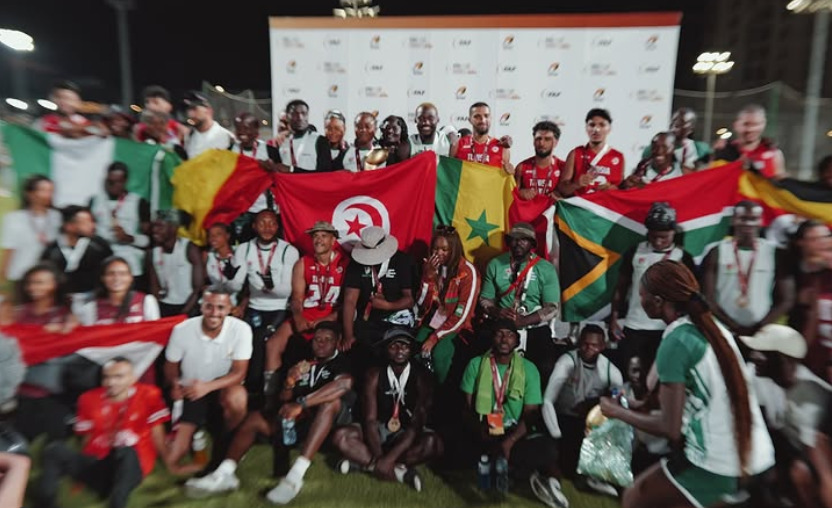

As the dust settles on Nigeria’s historic double victory at the IFAF African Flag Football Championships in Cairo, a pressing question now echoes across the continent:
Who truly represents African flag football—and who gave them the authority to decide?
Despite an electrifying performance by Nigerian teams, which saw the men’s team edge Egypt 13–12 and the women dominate Morocco 26–12, the aftermath has been anything but celebratory for all stakeholders.
What was meant to be a unifying milestone for the sport across Africa has instead exposed deep fractures, particularly in Nigeria, where athletes and investors are questioning the legitimacy of the power structures being formed.
A Victory Wrapped in Silence and Control
Multiple athletes who participated in the Cairo championship have privately raised concerns over emerging rhetoric within team communication channels. A troubling narrative has taken root:
“We are the ones who took Nigeria to Cairo. If you’re not in our league, don’t expect to play for the national team.”
These kinds of comments have alienated other private investors and leagues, some of whom have made significant contributions to the sport’s growth—including building Africa’s first standard flag football stadium, developing youth programs, facilitating scholarships, and launching international partnerships.
Their question is now urgent and direct:
Why are global stakeholders like the NFL and IFAF recognizing only one private body in Nigeria while ignoring other groups making substantial impact?
The Big Question to NFL Africa and IFAF
The NFL’s expanding presence in Africa, particularly through NFL Africa initiatives and partnerships with IFAF, has been widely welcomed. But now, many within Nigeria’s flag football ecosystem are asking:
Who is the NFL’s official representative in Nigeria?
On what basis has this individual or organization been endorsed?
Why is only one stakeholder being engaged, when multiple bodies are actively developing the sport?
Does the NFL endorse exclusionary practices that limit national team participation to members of a single private league?
Similarly, IAFA’s recent stance—allegedly encouraging other stakeholders to “write NAFA if they want to talk”—has raised serious concerns about the transparency and neutrality of international engagement.
“Africa is bigger than any one league. If NFL and IFAF are serious about developing this sport across the continent, why are they encouraging division?” one anonymous league official said.
Olympic Momentum at Risk?
With flag football set to debut at the 2028 Olympic Games in Los Angeles, the stakes have never been higher. Nigeria, home to some of Africa’s most talented players, risks being undermined by internal division fueled by external favoritism.
This isn’t just about one tournament or one title. It’s about the future of flag football in Africa—who gets to shape it, who gets to play in it, and whether the NFL and IFAF are truly committed to fair, inclusive development.
A Call for Clarity
The global flag football community is watching.
If NFL Africa and IFAF are to be credible stewards of the sport’s growth across the continent, they must urgently answer these questions:
Is there a single gatekeeper to flag football in Nigeria?
Will other private stakeholders continue to be sidelined despite their evident contributions?
Or will this moment in Cairo become a turning point for a new, unified vision—one that honors merit, transparency, and equal opportunity?
Until these questions are addressed, Nigeria’s gold medal may shine, but the foundations beneath it remain shaky.