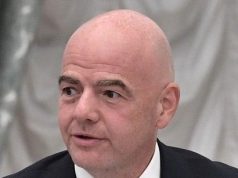
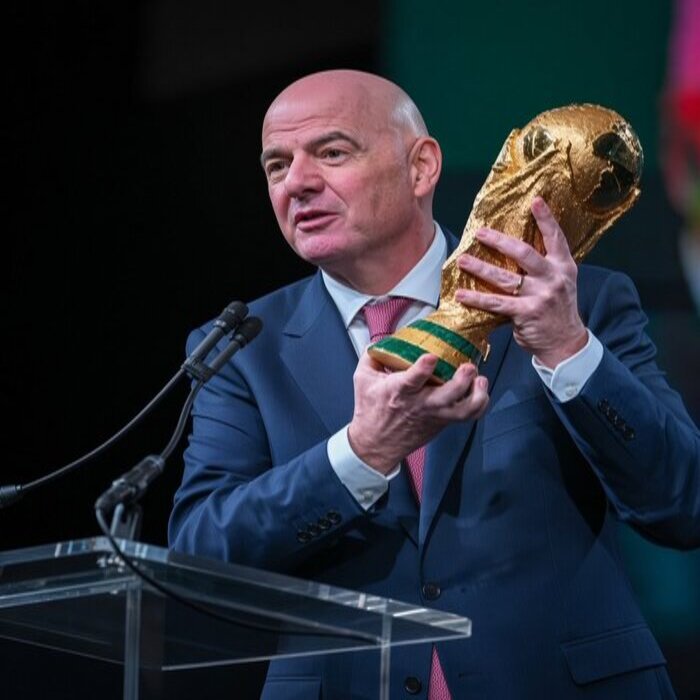
FIFA President Gianni Infantino has called for greater unity and a fairer distribution of opportunities in world football, insisting that the game’s biggest nations must not stand in the way of smaller countries seeking to compete at the highest level.
Infantino made the comments as pressure continues to build around his leadership ahead of the FIFA presidential election in March 2027, with UEFA and other football authorities increasingly challenging his approach to the governance and commercial direction of the world game.
Speaking after meeting representatives of the Caribbean Football Union in the Dominican Republic, Infantino said FIFA’s responsibility was to ensure that football continues to develop across all 211 member associations rather than allowing the gap between the traditional powerhouses and smaller nations to become wider.
“This is our task — this is our job,” Infantino said. “We want to grow football in every one of our 211 countries in the world.”
The FIFA president insisted that while the biggest football nations deserve recognition for their achievements, the rest of the world must also be given the resources and opportunities required to compete.
“The big ones, they are doing a great job, and we commend and congratulate them, and they should continue to grow as well, obviously, but we need to give a chance to all the others,” he said.
“We need to find investments for all the others — opportunities for all the others.”
Infantino went further by appearing to challenge those who, in his view, are unwilling to see football development spread beyond the traditional giants.
“Some, unfortunately, don’t need and they don’t want that others grow,” he said.
“But we need to narrow this gap between the big, big countries and all the others.”
His comments come against the backdrop of a major political battle within world football, with UEFA, the Asian Football Confederation and CONCACAF among the blocs that have raised serious concerns over Infantino’s leadership and his recently abandoned FIFA Forward Enterprise proposal.
The proposal had envisaged a new commercial structure for FIFA competitions, with Infantino arguing that it could generate additional resources for football development around the world. FIFA said the initiative could mean more investment in pitches, stronger national teams and greater opportunities for young players and women’s football.
However, the proposal triggered fierce opposition from several major football authorities before FIFA ultimately abandoned the plan. UEFA described the proposal as lacking transparency, while critics questioned the governance implications of putting future competition revenues into a new commercial structure.
Infantino has nevertheless continued to defend the broader philosophy behind FIFA’s development programmes, particularly the FIFA Forward initiative, which has channelled funding to member associations around the world.
“This is about, indeed, finding and giving opportunities, access, and resources to world football,” he said.
“That’s what we have been trying to do in the last ten years and also in the last ten weeks, and what we will be continuing to do in the next years.”
The FIFA president also stressed that the organisation’s decisions must continue to follow its formal governance structures.
“Everything we do goes then through the appropriate processes in FIFA, will be decided democratically by the Member Associations, by the FIFA Council, by the relevant bodies, always in strict compliance and respect of our rules and regulations,” he said.
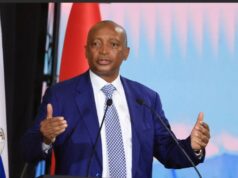
Infantino’s defence of greater opportunities for smaller nations has won significant support in Africa, where the Confederation of African Football remains behind his leadership. Cameroon Football Federation president Samuel Eto’o has also praised Infantino’s efforts to expand opportunities for countries that previously struggled to compete on the global stage.
But opposition remains intense, with several European and Nordic football associations calling for changes and questioning Infantino’s leadership ahead of the 2027 election.
For Infantino, however, the central argument remains unchanged: football cannot truly be called a global game if only its traditional powers are allowed to determine who gets the biggest opportunities.
“We need to narrow this gap,” he said.
And with the battle for the future direction of FIFA intensifying, Infantino is making it clear that his vision is one in which all 211 member associations, not just the biggest football nations, have a chance to grow.