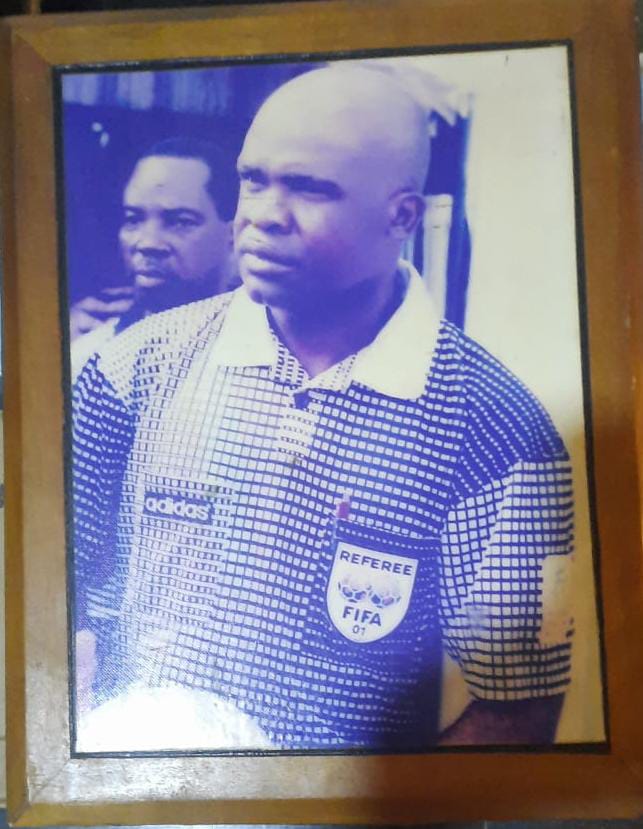

In this final installment of our three part exclusive interview with former FIFA-badged referee, Calistus Chukwudi Chukwujekwu, the highly-respected instructor tells Sports247 what Nigeria has to do to achieve a better presence for its match officials in the global refereeing scene…
Q: How would you rate the present state of match referees and referee instructors in Nigeria?
A: Refereeing has gone to a different level, and all we are planning now is to make sure we get everything right. The very first thing that I believe we have already achieved is that we now have highly qualified instructors who can go to the suburbs.
The task of covering a big nation like ours is not easy. You come back from an international course with new information, but you can not give them all out to everyone when you are located at a place that is far from them. So, we have to take refereeing to the suburbs by organising more national training programmes.
For instance, this July, we will call our premier league referees to Abuja to prepare them for next season. That would be in the form of pre-season training for them.
But, when we organise such programmes, we often notice that referees who should know the basic things of refereeing still have to be taught those basic things that they ought to already know.
So, one of the things we have achieved this year is to get in place some panels of instructors for both national and international levels. The international instructors will give us their gradings and we would make sure that we send them to the suburbs. Once they come back, we have new information to work on.
We’ll call them together, they’ll give us the information and we’ll work on new plans. We want our men to go to the suburbs to see what’s going on there. So that when you bring people to the centre for anything, you’ll be able to manage whatever information they have available that we can work on for improvements.
Q: Now that we have about 50 instructors trained, what are the expectations of the NFF from them?
A: The plan is that our instructors will get to every nook and cranny of this country. So, we have told them that if they are confused about anything, they should please reach out to us, and we’ll try to help in clarifying the situation.
We are also hoping that, maybe in the next one year, we’ll send our senior instructors to help the local ones and ensure that every corner of Nigeria is covered. That has been a problem we’ve been having with refereeing standards in this country.
For example, for three years now, we have instructed referees to note that if there is a foul close to the penalty area and the referee has awarded a free kick, then there should be a wall to be built by the defending team.
Before doing that, the referee must tell all the players to wait and hold on until they hear the whistle. The referee should also give a distance of 9.15 metres, which is the least to be given in this type of case.
Before now, referees were using backpedalling or sideways movement to get the 9.15m. However, modern football is teaching us that, at such a point, a bulk of the players usually would be in the penalty box.
So, why won’t the referee pay attention to them? If the referee backs them, a lot of things would be happening in the box. So, the referee has to work frontly, face them to see what they are doing, and manage the distance mentally. The referee will then apply vanishing spray to indicate where the wall will stand.
The referee should not bother about whether they shift the ball or not; just concentrate on the wall. Even if you don’t have vanishing spray, let your assistant and the fourth official help you with information around the ball while you deal with the bigger problem – which is pushing, shoving and pulling by players inside the area.
Q: There was a recent MA (FIFA Member Association) training for Nigerian referees in Abuja … tell us about it…
A: Yes, it was a young talent referees’ course that took place in June. Incidentally, even at that training for young talents, we found people who were still doing backwards marking of distance for a free kick wall. This means that the instruction had not reached them or it had not gone down to the interior regions of the country.
So, we are going to, hopefully, benefit from more courses like this. We also hope that our instructors who have been armed with new information will not go to sleep once they get back to their bases, because that means what they have would disappear from their brains if they don’t use it.
Q: What about expectations from FIFA about the current state of Nigerian referees?
A: FIFA’s expectations will come through the NFF. The process normally is that FIFA will be updated with the NFF’s expectations, which is regarding how regular information would get to everyone and everywhere in the country.
The most prominent aspect of FIFA’s expectations is that Nigeria is a big football playing nation, and our teams are present at almost all world tournaments – but so much of our referees is not seen in such tournaments! This is a charge that we have to face frontally and work on.
Q: Does this mean you have laid a foundation for Nigeria’s referees to return to FIFA competitions, as it was during your days?
A: That is something we are actively working on and hoping to achieve soon…
Q: … but we noticed that Nigeria’s top referees were not at the recent MA Course that took place in Abija. Was it an omission?
A: No, it was not an omission. The reality is that, every year, we have an opportunity to ask FIFA for courses, and we asked for three this year. We wanted an instructors course, a young talents course, and an elite course for FIFA-badged referees.
Our top referees would have been included in the elite course. Those were our requests, but FIFA, in their own wisdom, gave only instructors course and young talents course. They left the elite course out.
Pressing further, we found out that FIFA is more interested in seeing instructors and young talents trained, which is their preference over the elite referees. In fact, since we started MA Courses, the elite category has been a constant part of it.
At the same time, one of the areas of information we got from the FIFA instructor who came was that Nigeria has been given many courses, but we have not been able to show what we used them for as a country. They have not seen anything from us at the continental and world levels. Even at the national level, they just see flashes.
So, they decided this time that they wanted to see whether our young people could take up the challenge and, in fact, that’s the future for us. The fact that we need to train more people with the right information is more important to FIFA right now.
We even have further information that the most pressing interest from FIFA now is in female refereeing. So, next time around, we may decide to ask them for an all-female course ahead of any other course…
Q: … does it mean next year there will be a course meant only for female referees in Nigeria?
A: They might give us a females’ only course and two others. It would be the same way in which the MA Course we had this year was chosen and selected by FIFA.
Out of the three that we asked for, they selected two. But we later got to learn that we should know how to ask better and in a different way next time, so that we can get everything that we want.
Q: So, what are the implications for Nigeria from the MA course that took place in Abuja?
A: The implications for this year are that our top referees – national, international and elite – will get to know that these courses are not an exclusive preserve for them alone. We asked for their course, but FIFA did not give us.
So, let them realise that it’s not an exclusive preserve for anyone. It is something that is given by FIFA based on their own preferences. So, whenever you have the opportunity, you have better make the best use of what you are given.
Q: Last year, we saw many referees promoted to the NPFL after an MA Course. How many should we expect this year?
A: A lot of people would give kudos to the referees’ committee for the experiment we saw last year, and it worked very well for us. So, Nigerians should be rest assured that we will promote some referees after this year’s young talents course. However, what we do not want to do is move people too fast, so that they do not crash.
All the same, among the young talents that we brought this year, we have those that have been taking charge of NNL and NLO matches, but we don’t want to risk moving referees from NLO straight to the premier league.
We would rather move them gradually … that is from NLO to NNL and then from NNL to NPFL. All this, though, depends on the quality of what we see during the season and at the course.
Q: What can you then say about the standard of this year’s young talents course?
A: It was of international standard and taken by a world-class instructor. He gave us a feeling about what he saw in our referees and what he thought about their responses during the course.
We will now do the gradual sorting of those who participated and make sure we take useful decisions about the information gathered. Whatever the case, we’ll move referees from one stage to the next while still noting that the experiment of last year actually worked very well.
That was one issue that I discussed with a FIFA technical instructor who stayed a little longer at the end of this course after the physical instructor had already left.
One of the major take-home for me was that the instructor was quite satisfied with what he saw. He came from the CECAFA region. He’s from Somalia and a member of the referees’ committee in CAF.
All he kept telling me was that he wished to have this band of young talents that he saw in Nigeria and he would go to places with them. He said, ‘I will make World Cup referees from them.’ That was to show that Nigeria’s potential in refereeing is bright.
For me, that was something very, very elating. It reassured me that, though we have constraints here, especially in terms of not moving on with these courses as regularly as we should, we still have our strengths.
I remember it was in 2016 that I had the privilege of training with UEFA referees, and I realised then that one of the things that people do internationally in football is that they fail to see the money in it. So much money is in football.
That’s why we have to properly prepare the people who will take all the vital decisions that affect results in each game. So, we must ask ourselves, ‘Are we giving enough training to our referees here?’
For the man from Somalia, he expects that this band of young talents should be moving forward according to their potentials and through a well laid out plan from those in charge of refereeing in the country.
Q: What then is the way forward for referees and refereeing in Nigeria?
A: We have to look at a lot of new concepts, new ideas and innovations. We must not wait until the ball is kicked before we take action because, when the ball is already kicked, you will not be able to follow the flight of the ball.
We always tell our referees, ‘If you notice that there’s nobody covering a particular player, move closer, so that when the ball is landing, you are near the point of impact. You must always be at the right spot.’ They must also take note that the penalty area is a very crucial portion on the field, and we need to watch such places during a match.
Q: What about the introduction of technology into Nigeria’s refereeing sector?
A: That’s another key aspect we are looking into. In fact, nowadays, there’s something called video support system, and FIFA has instructed that every nation should get it. This is because of controversies that often occur during matches, but we all know that the more common video assistant referee is very expensive.
VAR is very expensive in terms of equipment, installation and maintenance, but football video support is a new one that can be used with just one monitor and a few cameras.
It involves only the fourth official and the referee at the centre but does not need video assistant officials. So, that’s a new thing that we can implement in Nigeria.
I am happy that the NFF is even moving faster in this regard. They are taking advantage of a situation in which CAF have provided West Africa Zone B with some equipment for VAR, with which we can train referees.
It’s located in Cote d’Ivoire, and NFF is already thinking of using a van to move that equipment to Nigeria and have the opportunity to train more VAR officials.
The advantage of this is that, very soon, knowledge of VAR would be a crucial part of the selection of referees for different levels of tournaments.
Q: Is there any part of refereeing rules that you find to be controversial?
A: I would say most recently I’ve been attracted by the concept of eight seconds limit for goalkeepers to kick the ball upfield after catching it. It’s something that’s been bothering me for a long time before now, and I’m happy that it has been taken up among the new rules of football.
In fact, it comes in place of the former six seconds rule that many referees did not like to implement because it meant giving an indirect free kick inside the box. However, with a corner kick now the punishment for any default on the eight seconds rule, this will be easier to implement, and it will surely eliminate time wasting by goalkeepers in football. Is it not something good? It surely is!
Q: Your story and experiences are quite interesting, but has there ever been a day you regretted being a referee?
A: I never regret each opportunity I get to be a referee. Even when the fans are unruly or the players become hard to control, it’s always lots of fun for me. However, there was once a time when I actually thought of quitting due to ill blood from some people towards me.
I remember a particular episode when some people went around saying I wasn’t passing my physical tests in those days. So, they set up a training programme and brought a lot of people to come and see me fail. I just came there and started doing my runs normally as I should. I ran and I passed all the tests.
It was not until two years later that someone told me that the training programme, which took place at Sani Abacha Barracks, had been filled at the four corners of the field with men who had been paid to pray for me to fall down and die while I was running. They wanted me to fall so that their claims about my lack of fitness would be justified.
That was one of the reasons why, immediately after retirement, I went into oblivion … until an angel outside Nigeria brought me back.
So, instead of regrets, I’m full of thanks to God for the opportunities he’s given me. Particularly after I returned from where I went when I ran away from refereeing. I decided to do other things; but the truth is that refereeing is in my blood. It is my life.
When I was brought back, I realised how much I love refereeing. That’s why I tell people these days, ‘If you are in love with anything, don’t let someone push you away from it. Stay in and face it, because it gives you special joy.’
I run, I shout and I pass instructions for a week in a classroom, but I never get tired; that’s because I enjoy doing it. Many times, we do what we do and nobody pays us a farthing, but we are enjoying it. Because you enjoy it, you are very satisfied with it. So, I don’t have any regrets. God has been awesome to me.
Q: What message do you have for any young person aspiring to be a football referee?
A: My message is still in line with what I just said about no regrets. I will use myself as an example for every young person out there who wants to become a referee. I enjoyed being a centre referee, and I’ve been enjoying myself more since I got back in 2014 as an instructor. I go to courses, I learn new things, and I meet different people.
So, one of the things I tell people is that a good turn deserves another. In anything you do, always know that people are taking note of you. Just keep working and keep your trust in God, who is the giver of every opportunity.
Q: Any message for the NFF … and your personal promise?
A: My personal promise is that I will continue to work hard and be part of all progressive programmes of the referees’ committee. We’ll do all we can to lift up aspiring referees and the young talents already discovered in the system.
We’ll involve them in courses like the recent one we had in Abuja, where I personally brought in a young man who I discovered last year.
I want to assure them, ‘Just keep working hard and we’ll notice you one way or the other, God helping us.’
As for the NFF, I want to say thank you to the current administration led by Alhaji Ibrahim Musa Gusau. I say thanks to the Gusau-led board for how they have been supporting us tirelessly. We say thank you, even as we look forward to getting more support in future. Thank you very much.
Q: Thanks to you too, sir. It has been a very long interview … very interesting, very informative and very entertaining. Unfortunately, we can not cover everything you have and get it within this short time available. We hope to get more from you some other time, sir. Thank you for giving us your time, sir.
A: Thanks for having me.