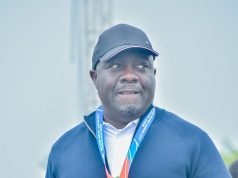
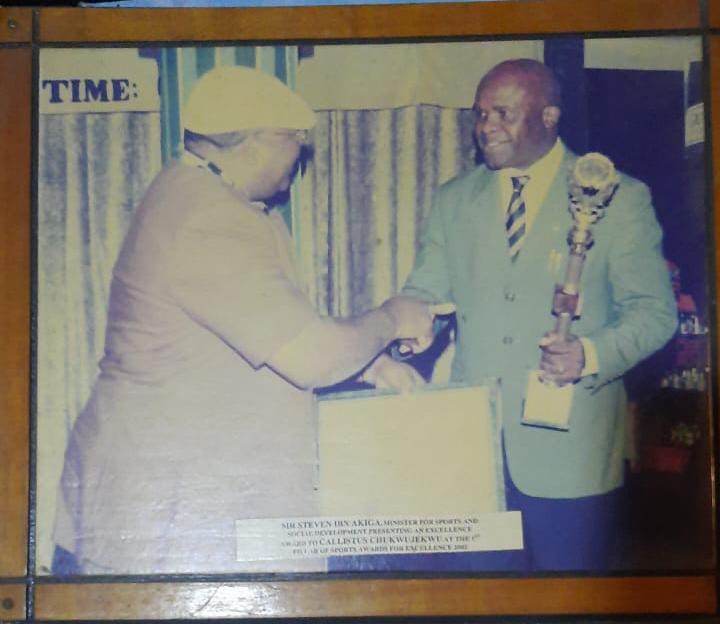

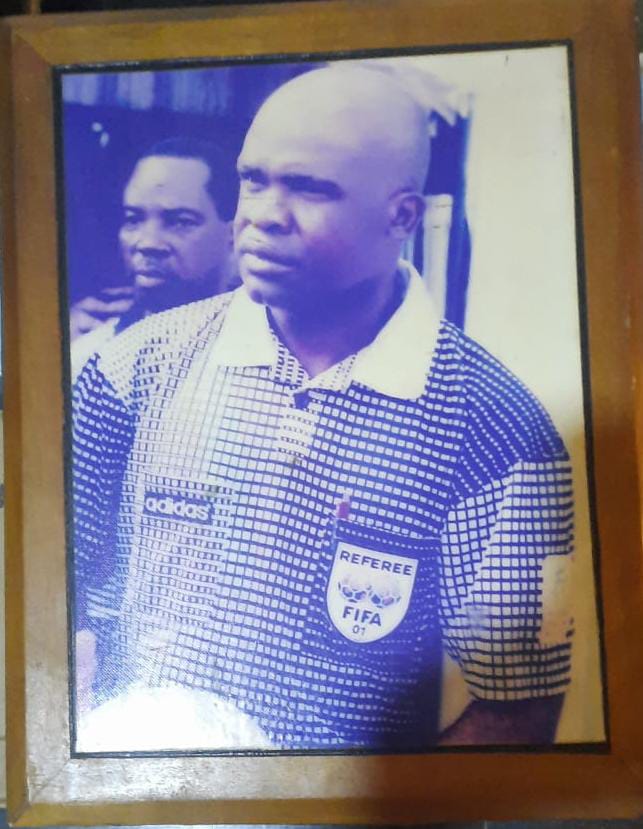
Renowned FIFA-badged referee, Calistus Chukwudi Chukwujekwu sat down with Jide-Ojo JIDE OLUSOLA for this 3-part exclusive interview, in which the amiable arbiter revealed how he was on the verge of becoming a Catholic priest until a handball coach introduced him to refereeing; and how he overcame politics of the trade to become one of Nigeria’s best ever football officials.
Read Also: “Something Is Strange at Arik Air”—Passenger Shocked Again As Economy Class Feels Like Business
Q: Let’s start with your nickname. Many people call you ‘CCC’ … kindly tell us what it means.
A: CCC represents my initials. It stands for Chukwudi Calistus Chukwujekwu. Those are my official names. I don’t know whether they were accidental, but they are turning out to be what everybody knows me with in my football life, my refereeing life and in a whole lot of things that I do.
Q: Many people may not know about your football life. Please tell us about it…
A: My football life started when I was in secondary school. That was in the 70s. I actually attended a Catholic seminary in the South-East, but I played football in school, and I loved football. Like every other young boy, I wanted to have something to do with football. However, the constraints of my school and the kind of training I was into made it impossible for me to continue.
Q: Did you think of playing for any football club at that time?
A: Rangers were in vogue at that time as well as Spartans football club of Owerri. Then Vasco da Gama of Enugu were also in vogue at that time. If you didn’t play for Rangers or Vasco da Gama, you could go over to the then newly created Imo State and play for Spartans.
So, these three teams attracted every young man who thought he could play football, and we were all looking up to them. But then, I was in training for the Catholic priesthood, and that wouldn’t give me the opportunity to play football.
Q: How then did you get into football refereeing? Was it like a miracle?
A: It was something close to that. It happened that, usually, after the school certificate examination, we would have the opportunity of one year apostolic work, and I had the privilege of teaching in my alma mater.
While I was teaching, the seminary opened its doors to handball. I wasn’t a fan of handball, but the coach who came from the then Anambra State Sports Council, Onitsha office, was also a football referee.
On noticing that there were some of us who were young people who were teaching in the school, he asked the seminary’s director, who was a reverend father, to give him permission to take us out as football referees. The director granted him permission. So, those of us who wanted to do something with football now had the opportunity.
Somehow, the seminary allowed us to do football refereeing, and that was how it started for me. In fact, it was in 1980 that I started my career as a football referee in Onitsha. A year later, I had to go to the senior seminary in Ikot Ekpene, which was at that time in Cross River State, and I was there able to continue my progression as a referee.
Q: Did you face any challenges at that time?
A: Usually, once you enter refereeing, you would have at least one year in training. So, my year in training culminated into my entry to the senior seminary.
Over there, we were instructed to observe one spiritual year, during which you had no permission to belong to any social group of any kind. You must focus fully on your spiritual calling. That meant I could not write my first referees’ grading exam until 1983.
As fate would have it, though, the leaders of the referees at Ikot Ekpene were very happy with me. They eventually told me that I was the best graduating candidate of Grade 3; and that spurred my interest further in refereeing.
Q: What happened afterwards?
A: By 1985, I was done with my theological training in Ikot Ekpene, and I came out happily, but I couldn’t continue on that line in Enugu. So, I moved to Onitsha, where I eventually wrote my referees’ Grade 2 exam in 1986.
After that, I decided to do a master’s programme at the University of Nigeria, Nsukka. After graduation, although I had an exemption from NYSC, I decided to go for it.
That took me to Ondo State in 1990, and that was where I had my Grade 1 exam. That also marked the beginning of my advent into active refereeing, and it coincided with the start of professional football in Nigeria.
Q: Would it be right to say your interest in refereeing stopped you from becoming a reverend father?
A: I will say not fully, but maybe partially. There are reverend fathers who are referees. It was just basically because we faced some restrictions in those days. At the same time, the Catholic priesthood is a vocation that God calls you into it. God will get you if He wants you, no matter where you run to … just like the story of Jonah in the Bible.
So, I may say I was not called to be a priest, but where I am now, I am doing so well. So, it could be that God called me for something else, and that’s where I have found myself.
Q: Was it that the seminary did not encourage you to play football?
A: We were actually playing football there, but the level we had couldn’t take us to any club. That was mostly because of the restrictions I spoke about earlier.
Although they had Seminary Games that were holding every two years, we all had fears about injury that could put our ordination in jeopardy. That was what happened to one of our colleagues who became a deacon in the seminary.
He was told to play in the Seminary Games, but he refused because he was afraid of getting injured. The rector considered it as disobedience and expelled him, but the young man reported the matter to the bishop, who happened to be the then Archbishop of Onitsha, now present day Cardinal Arinze, who approved his return to the seminary.
However, a few months later, Awka Diocese was created out of Onitsha Archdiocese, and the rector became the new head. That started another crisis in the boy’s life; but he was eventually allowed to be a priest in Onitsha Diocese.
That was just to show that there were cases of restrictions or situations where people could get injured, and the church would say you can not continue your priesthood because of deformity.
On the other hand, things have changed, and there are those who had already become priests but survived accidents, and their hands were cut. However, the Catholic Church would still take them back. Even if you run away and get married, the church believes you are still a priest.
So, it wasn’t handball, football or refereeing that stopped me from being a priest. It was just that I had not been introduced fully to the priesthood. So, the handball coach saw that as an opportunity and, back then in Onitsha, they needed us.
They had so many matches but had few referees. So, I didn’t even train for one week before I got involved as a referee of matches in Onitsha. They needed people like us, and it was easy to buy black cloth then quickly sew our uniforms. That was how it started for me.
Q: What was it like at the beginning?
A: It was quite interesting. Although we sometimes made mistakes, the coach would keep encouraging us. He is still there, living in Onitsha, Price Donatus Mbaezue I call him my master, I call him my mentor … everybody knows him as my father. He introduced me to refereeing. By the time I went back there in 1986, he was still there in Onitsha.
He gave me all the courage that I needed, and one thing led to another. I went for a master’s programme, and by the time I was moving to Ondo, I was already a known name at the lower level of refereeing. All I needed was to pass Grade 1, and then they would start checking whether I would be there or not at the national level.
We didn’t know about FIFA referees at that time. All we knew was that there were league matches, and referees were officiating them. As a Grade 2 referee, I had already got the opportunity to go for a league match because they saw some potential in me; and that further spurred my interest.
Q: Tell us about your most memorable match in the Nigerian professional league…
A: Wow! That one’s hard to remember. I actually started refereeing Nigerian professional league matches in 1993. I can’t give the details, but I remember that, having been exposed to national league matches, what we called Division 2 at that time, I had been looking forward to an opportunity in the professional league.
I know that I had a lot of matches at that point, but one that strikes my memory most was IICC versus Stationery Stores in Ibadan. It was a very controversial match.
Lorry loads of Stationery Stores supporters were stopped at the toll gate from entering into Ibadan because they were carrying all kinds of weapons. It was like a warfare. Security details said, ‘Let’s cut this down.’ But many of them still found their way into Ibadan.
When they got there, they found out that the referee to officiate the match, that’s me, was coming from Anambra State. So, they carried a story that the Igbo man who was to officiate the match would be taught a lesson. However, instead of that threat bothering me, that was the push for me to do better in that match.
In fact, the late Festus Okubule was at the game, and he made up his mind at that time … it was 1993 … to keep me on his list of top referees.
So, in 1994, when I had the opportunity to be called up for international referee assignments, Okubule never left me out. The late Sunny Badru and all of them that were in the panel said, ‘This is the kind of young man that we want.’
To God be the glory, I was listed as an international referee in 1994, and it took effect on January 1st, 1995. Since then, I’ve climbed and got to a point where I can say all glory be unto God.
Q: What was the experience like being an international referee?
A: It was an awesome experience, though full of politics that goes into handing out matches.
I can recollect that, at that time, once you got to the international level, your country had a hand in your upliftment. But, for me, I had only one match after I was confirmed on Janusry 1st, 1995.
What CAF would do in those days would be to ask Nigeria to provide three referees for preliminary stages of club championships. But, probably because I was unlucky, I never had a mention at that level. It was later I got to hear that the people in power were also interested in what I deserved to get.
They had the knife and the yam. So, they could cut the yam the way it pleased them, and they could cut it for anybody they wanted. One of the reasons I later heard why I wasn’t getting a mention for matches was that I would be easily noticed once I got out there. That was why I had only one international match, and that was in Garoua, Cameroon.
Q: How did you overcome the hurdle and eventually get to the high point of your FIFA grading?
A: Well, somehow, we kept going. Although the powers that be never gave me another opportunity, a turning point eventually came for me. Fast forward to 1998 … three years down the line. Nigeria was hosting the first edition of the Women’s Nations Cup in Africa.
The host cities were Abeokuta and Kaduna. Our elderly brother, Linus Mba was to be the coordinator of referees and my humble self to be the assistant coordinator. That meant I had to invariably work under him.
However, as fate would have it, the late Major Lamptey from Ghana was to be the second member of the referees’ committees of CAF in the tournament. He was to coordinate the Kaduna leg, while chairman of the referees’ committee, late Farah Addo from Somalia, was to coordinate the Abeokuta centre, with Linus to assist.
Unfortunately, Major Lamptey took ill and couldn’t come from Ghana. So, Farah said Linus should go and oversee Kaduna, and I stepped up to being the coordinator in Abeokuta.
Q: How did it go for you, and what’s your biggest memory about it?
A: Probably because of the training that I had as a young man in the Catholic seminary, I was able to do my best as the coordinator, and I was noticed by people who mattered. I was just being diligent about my responsibilities.
Paying attention to little details, especially time management, punctuality and proper organisation of things. The way I met all their needs and arranged meetings were noticed by the referees’ committee chairman, Farah Addo, who was also a vice-president of CAF. So, by the time he was leaving Nigeria, he left with a very good impression about me.
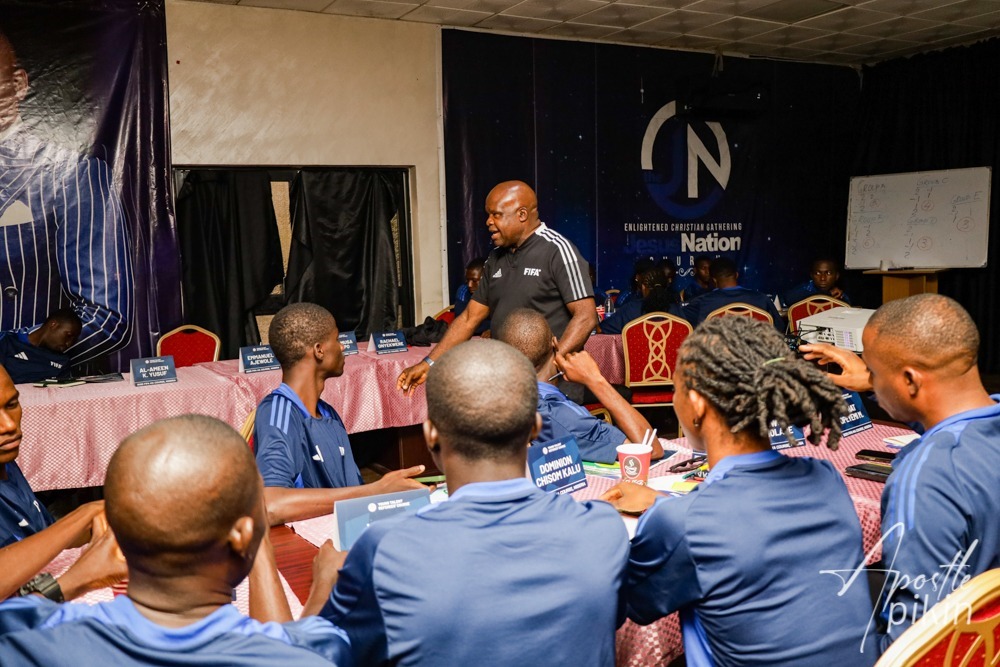
The following year, 1999, Nigeria was going to host the World Youth Championship, now called U20 World Cup. My late friend, Chris Eseka, a very close friend to me, helped me see Patrick Okpomo, who was the director of organisation for Nigeria ’99. We had discussions before he went for FIFA’s briefing in Zurich, and by the time Okpomo returned, he disclosed that I had been appointed as coordinator of referees for Nigeria ’99.
He also disclosed that, when he me Farah Addo in Zurich, he was told that if it is not me, no other person would be chosen from Nigeria. That was my greatest, greatest opportunity. That was the greatest opportunity God gave me in refereeing.
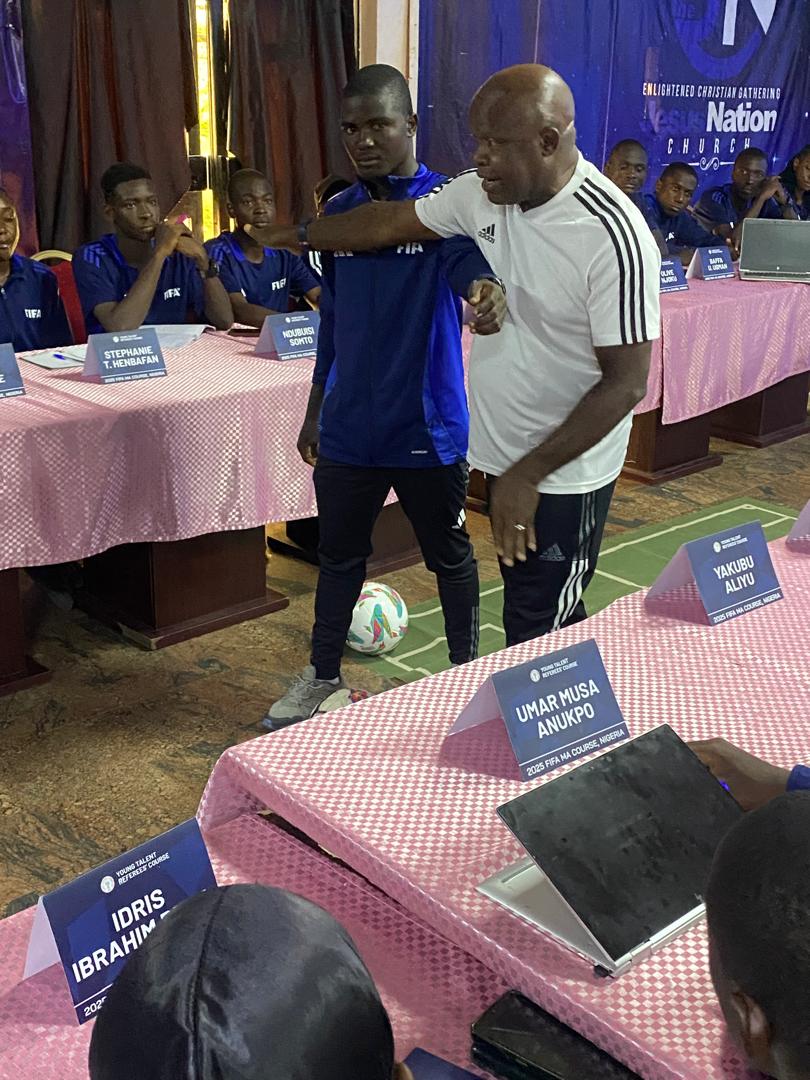
That was my turning point, and I became an ‘errand boy’ for the referees at Nigeria ’99. I did all that I could. I arranged a lot of meetings, fixed places, got funds from CAF leadership, arranged hotels for delegates and did many other things that needed to be done during the competition.
After it all, the man felt I was humble and diligent enough to be saddled with responsibilities. That opened many other doors for me in CAF.
– To Be Continued In Part 2