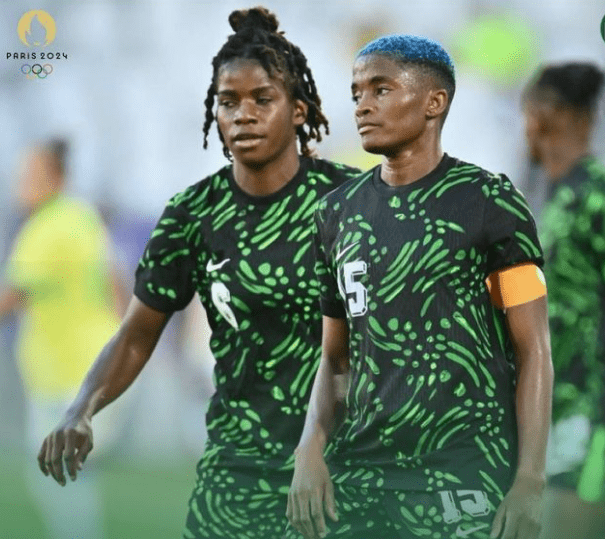
Super Falcons captain Rasheedat Ajibade has urged Nigeria to learn from its disappointing campaign at the 2026 Women’s Africa Cup of Nations rather than dwell on the disappointment of missing out on the FIFA Women’s World Cup for the first time.
The Super Falcons’ hopes of reaching the 2027 FIFA Women’s World Cup in Brazil were ended on Thursday after a 2–1 defeat to South Africa in the crucial CAF play-off in Casablanca.
Read Also: NIGERIA HAS LOST ITS WOMEN’S FOOTBALL ADVANTAGE — AND AFRICA IS CATCHING UP FAST | Sports247 Nigeria
Nigeria had already lost 1–0 to Cameroon in the WAFCON quarter-finals, meaning the defeat to Banyana Banyana completed a disappointing campaign for the 10-time African champions.
Ajibade believes the setback should serve as a wake-up call for Nigerian women’s football.
“There are a lot of lessons for us to learn from this. This is a wake-up call for us to rise again and not rest on our laurels.”
The Paris Saint-Germain midfielder acknowledged that the rest of the continent is improving rapidly and warned that Nigeria can no longer rely solely on its reputation and historical dominance.
According to Ajibade, African teams are increasingly closing the gap, making it necessary for the Super Falcons to raise their standards both individually and collectively.
She called on her teammates to demand more from themselves and use the disappointment as motivation to improve.
The Super Falcons had entered the tournament as defending champions and the most successful team in WAFCON history, but their campaign began with a shock 1–0 defeat to Malawi before they recovered with a narrow victory over Zambia.
After overcoming Zambia, Nigeria fell to Cameroon in the quarter-finals before losing to South Africa in the World Cup play-off.
The outcome brings an end to Nigeria’s remarkable record of appearing at every FIFA Women’s World Cup since the inaugural tournament in 1991.
Ajibade believes the historic setback must now force Nigerian football to take a serious look at its development and preparation.
With several African nations investing heavily in women’s football and narrowing the gap with Nigeria, the captain says the Super Falcons must respond by raising their standards and rebuilding for the future.
Nigeria’s historic World Cup absence has therefore provided a major warning that past dominance can no longer be taken for granted in African women’s football.