
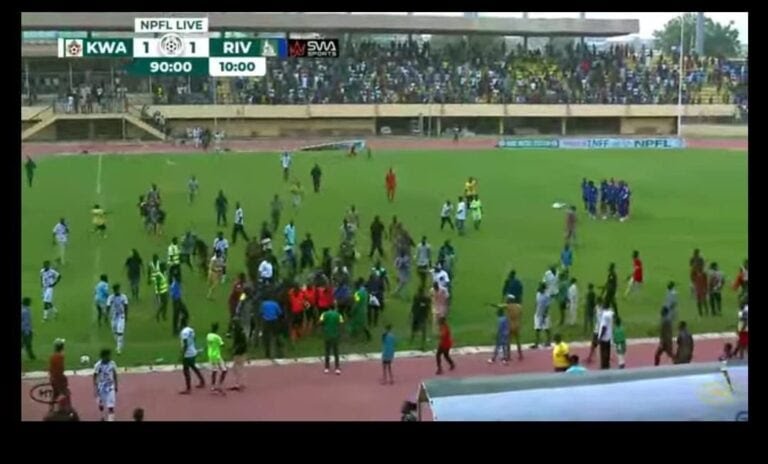

Veteran football administrator and former General Manager of Julius Berger FC, McTony Taiwo, has raised serious concerns over persistent security lapses in the Nigeria Professional Football League (NPFL), Sports247 report.
Taiwo stressed that the situation poses a major threat to the league’s growth and credibility.
Describing the recurring incidents of violence at match venues as “embarrassing,”
The administrator called on the League Management Committee (LMC) to enforce existing regulations more decisively in order to restore sanity and confidence in the domestic league.
Speaking on the ongoing security challenges confronting the NPFL, Taiwo stressed that responsibility rests squarely on the shoulders of the LMC to take firm, consistent decisions.
“The League Management Committee has a lot of work to do. Security must be taken seriously from the pre-match meeting to the final whistle,” he said.
Taiwo argued that no match should be allowed to proceed if agreed security measures are not fully in place, insisting that match commissioners must be empowered to take decisive action.
“If the match commissioner observes at the pre-match meeting that security is inadequate, he has the absolute right to rule that the match will not hold,” he explained.
READ ALSO: Ex International, Godwin Okpara Weighs In on Super Eagles Coach Chelle’s Contract Demands
“Once that happens, the home team should automatically lose three points and three goals, while the visiting team gets the points.”
According to him, such uncompromising measures would send a clear message to clubs and act as a strong deterrent against negligence.
The former club administrator also highlighted what he described as a disturbing pattern of security personnel abandoning their posts during matches.
“You see security personnel at the beginning of the match, but as the game goes on, they start disappearing,” Taiwo noted.
“Maybe they were not paid, maybe they compromised — but whatever the reason, it is unacceptable.”
He emphasized that supporters must not be allowed access to the field of play until players, match officials, and referees have completely exited the pitch.
“It is really embarrassing when football, which should be entertaining, turns into a situation where players or officials are stoned or attacked with bottles,” he added.
Taiwo further criticized what he termed inconsistency in the application of disciplinary measures across clubs, warning that selective enforcement undermines the integrity of the league.
“What is good for the goose must be good for the gander,” he said.
“If a club is fined ₦5 million or ₦10 million, banned from its stadium, and docked three points, then that same rule must apply to everyone.”
He cautioned that perceptions of favoritism, whether real or not, only encourage repeat offences.
“From what people read on social media, it appears some clubs are favoured. I am not saying it is true, but perception matters,” Taiwo stated.
Reflecting on his years in football administration in Lagos, Taiwo recalled that visiting teams were never attacked under his watch.
“We never had a case where visiting teams were assaulted by our supporters,” he said.
“The only time we were moved from Lagos was for logistical reasons, not crowd violence.”
He also recounted experiences from the 1990s, including matches relocated to Abeokuta and Akure, noting that even in those instances, violence was avoided.
Final Verdict: No Security, No Match
Taiwo concluded by reiterating his call for zero tolerance on security breaches.
“If a club promises 50 policemen and only 20 show up, the match should not continue,” he declared.
“That is a walkover. When clubs start losing points this way, then everyone will know the league is serious.”
He expressed optimism that Nigerian football can overcome its security challenges, but only with firm leadership and consistent enforcement.
“It should improve one day — but only if the organizing committee stands firmly by its decisions.”