
A startling verdict has been passed that Nigeria’s indigenous football coaches are not qualified to handle the national team, Super Eagles, Sports247 reports.
While criticisms continue trailing the presence of a Franco-Malian tactician, Eric Sekou Chelle as the Eagles’ head coach, the latest declaration appears to support his appointment by Nigeria Football Federation (NFF).
Read Also: Fikayo Tomori Optimistic Of ‘Adding Joy’ To His AC Milan Aspirations, 2026 World Cup Dream | Sports247 Nigeria
This is based on stunning words from a vastly experienced coach and instructor, Akande Fatai Adejumo Smith, who revealed that only a handful of Nigerian gaffers have the required papers that would qualify them to take charge of their national team.
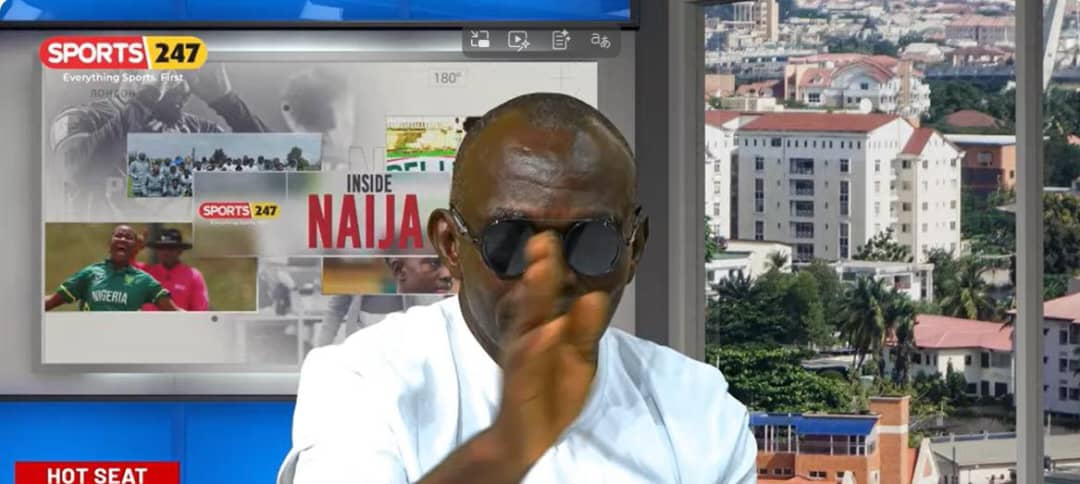
Coach Akande made this disclosure while speaking during ‘Hot Seat’ segment of Inside Naija Sports, a live streaming programme on YouTube, from the studio of Sports247 Naija TV, starting 11:45am every Friday.
The member of Football Coaches Association of African Nations (FCAAN) pointed out that the setback was caused by a series of ugly issues that stopped Nigeria from hosting a continental coaching course for almost ten years.
He averred, “We got a coaching course back in Nigeria this year after almost ten years that they stopped the country from hosting any. You can imagine what it means not to have a coaching course for about ten years.
“The external instructor who was sent to us by CAF was from Zambia, and I happened to be the class governor. He told us that we had missed a lot, and we were now ten years behind the rules of modern coaching.”
Aside from pointing out that most Nigerian coaches fall short of requirements to take charge of their national team, Smith went on to reveal that many current gaffers of clubs in the top-tier of the domestic league will also soon become inelligible to sit on their team’s benches for continental matches.
He added, “Starting from 2026, no coach can sit on the bench of a team playing international competitions if he does not have a CAF B-licence.
“However, the pool of Nigerian coaches with the B-licence is just 25. This means, for the national team category, we don’t have many indigenous coaches that are eligible to work at that level.”
The articulate tactician, who played for clubs in Singapore and Malaysia during his active days, revealed further that things are bound to get even tougher for Nigerian coaches in 2027, as only those with A-licences would be recognised internationally.
Smith further disclosed, “Because of how we missed hosting courses for so long, CAF gave us a lifeline for a year. But, from 2027, if you don’t have an A-licence, you cannot sit on the bench even as an assistant to the head coach.
“They can allow someone with a B-licence for the Super Falcons, but it’s only an ‘A’ for the Super Eagles. So, we have to start checking how many coaches we have that hold a B-licence all over Nigeria … not to even talk about an A-licence.”
He, however, absolved Nigerian coaches of any blame for negligence or complacency, saying instead that the lack of a coaching course in the country caused the ugly situation; but added that corrective steps have already started.
Smith, who is currently in charge of Vinod Football Academy of Lagos in the third-tier Nationwide League One (NLO), conceded, “The 10-year absence we suffered left us in the wilderness. A lot happened that caused things to be the way they are.
“Simply put, we were not doing the right thing. But we should give kudos to the body that I work for, FCAAN, led by Dr Babatunde Eguaoje, who is based in the USA.
“He was able to work with the NFF’s technical director, Augustine Eguavoen, to make sure these courses were brought back to Nigeria.
“They had to come up with a curriculum that specified what each course would be about. Every nation has to develop its own curriculum, then take it to CAF.
“They will vet it, and if it’s seen to be okay, they would then implement it for D-level, C-level, B-level, and A-level. We’ve done courses for all the lower levels, but not yet for the A-licence,” Smith concluded ominously.