
In the rich tapestry of Nigeria’s political and sporting history, few stories resonate as powerfully as that of President Muhammadu Buhari’s decision—over three decades later—to reward the victorious 1985 Golden Eaglets team, Nigeria’s first-ever world champions.
It was a symbolic act that transcended mere presidential duty; it was the fulfilment of a promise interrupted by the tides of power and politics, and ultimately kept by a man whose life has been defined by discipline, resilience, and commitment.
Read Also: SSA Adeboye Mourns President Muhammadu Buhari: “A Towering Legacy Of Discipline, Patriotism, and Integrity”
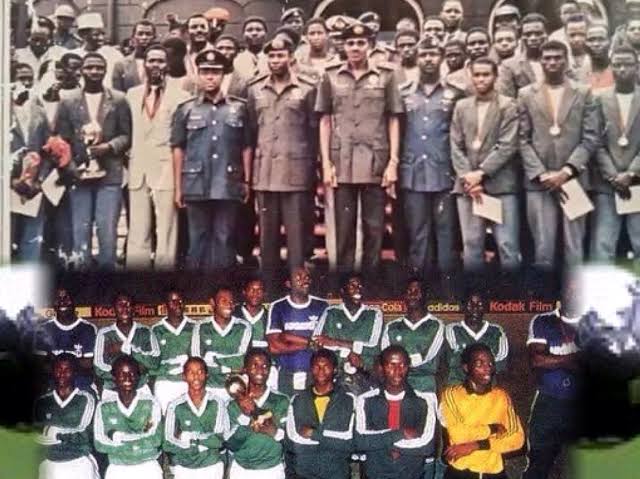
In August 1985, under Buhari’s military regime, Nigeria’s youth team stunned the world by winning the inaugural FIFA U-16 World Championship in China, then sponsored by Kodak.
The young Golden Eaglets, captained by Nduka Ugbade, became instant heroes, and President Buhari, then a no-nonsense military head of state promised them a national reward befitting their historic feat.
But fate intervened. On August 27, 1985, just weeks after the team’s triumph, Buhari was overthrown in a palace coup led by General Ibrahim Babangida.
The promise, along with many aspects of his interrupted military agenda, was shelved.
Fast forward to 2015, and history presented Buhari with a second chance, after three unsuccessful attempts, he was elected President in a democratic dispensation.
Many doubted whether a man once known for strict military austerity could transition into the complexities of democratic leadership.
Yet, it was during his second term that Buhari quietly delivered on a pledge most had long forgotten or dismissed as buried under the weight of time.
In 2021, President Buhari honoured the 1985 Golden Eaglets team with national awards and financial rewards.
He didn’t have to. There was no political pressure, no media campaign, no public outcry. But for Buhari, it was about honour, duty, and a personal commitment.
“I made a promise to these young men 36 years ago, and I’m here today to show that Nigeria does not forget,”
Buhari said during the presentation.
It was a defining moment that revealed not just the integrity of a leader, but the enduring weight of a leader’s word.
A Life Marked by Discipline and Determination
Born on December 17, 1942, in Daura, Katsina State, Muhammadu Buhari rose through the ranks of the Nigerian Army, commanding respect for his spartan lifestyle and commitment to national service.
As military head of state from 1983 to 1985, he launched a controversial but focused War Against Indiscipline (WAI), cracking down on corruption and mismanagement.
Despite being ousted, Buhari’s legacy endured. His reemergence in 2015 as a civilian leader represented more than a political comeback; it symbolized Nigeria’s complex journey from dictatorship to democracy—and the reinvention of one of its most polarizing figures.
By fulfilling a promise made in 1985, Buhari did more than honour a team. He sent a message that leadership, at its best, remembers.
That justice delayed can still be justice delivered. In a country often plagued by broken promises and abandoned commitments, Buhari’s gesture was both rare and remarkable.
It showed that history does not have to remain unfinished. That even after decades, the arc of responsibility can bend towards fulfilment.
While critics may debate his policies and politics, Buhari’s decision to reward the 1985 Golden Eaglets remains a legacy marker. It captures the essence of a man often misunderstood but steadfast in his beliefs.
A man who, despite the odds, lived up to his word, a disciplinarian whose words was his bond.
In a nation hungry for accountability, this act stood out, not just for its symbolism, but for its sincerity.
For Muhammadu Buhari, it was never just about power. It was about purpose—and the promise kept, even after 36 years, told that story better than any speech ever could.