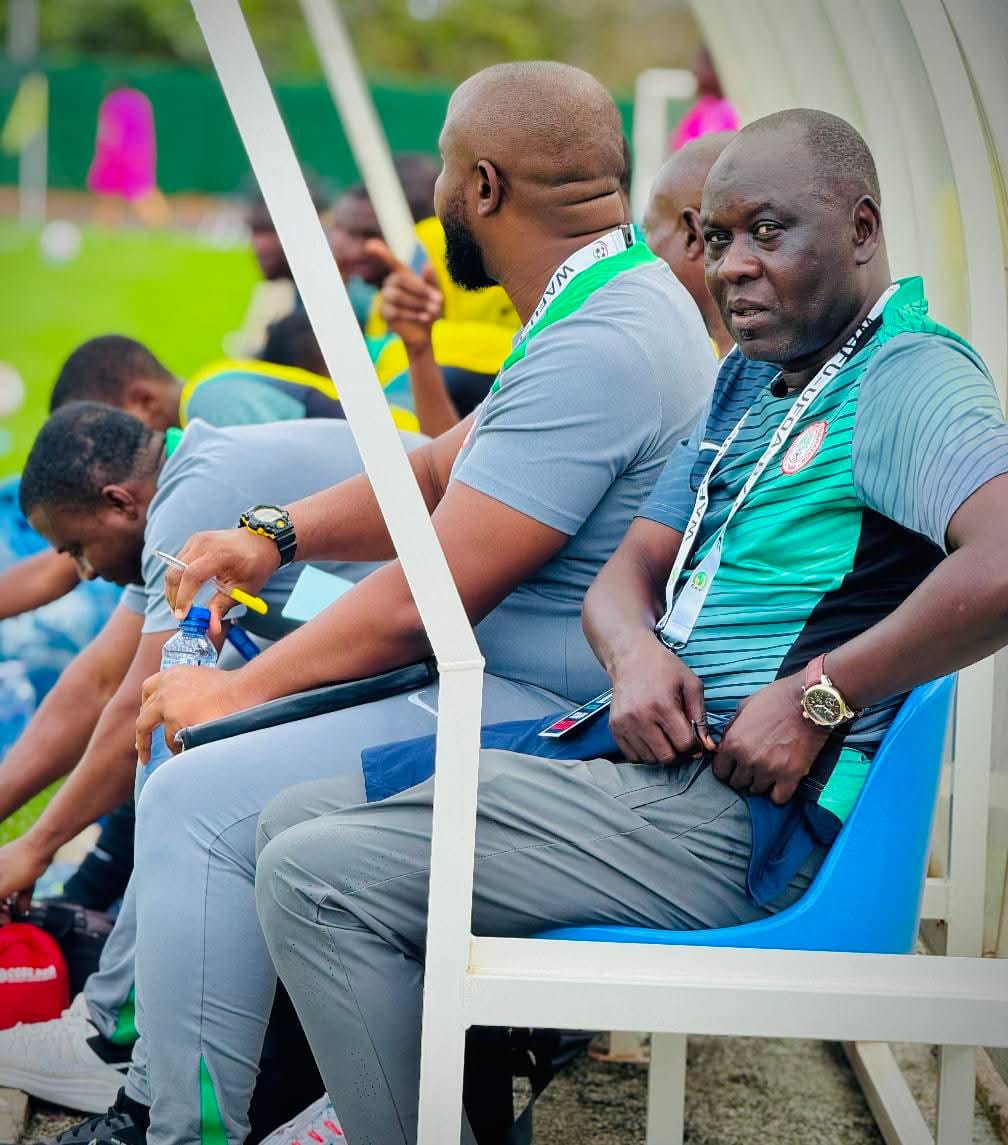

UAE 2013 FIFA U17 World Cup winning coach, Manu Garba has failed in his second attempt to revive the once glorious surge of Nigeria’s Golden Eaglets as the most successful team at the global cadet championship, Sports247 reports.
Garba’s latest slump came on Tuesday evening in Yamoussoukro, Cote d’Ivoire, where his side lost 2-0 to Ghana in the semi-finals of this year’s West African Football Union (WAFU)-B U17 Championship.
Read Also: Golden Eaglets Disgrace Nation Again: Nigeria Misses Another U-17 World Cup After Ghana Defeat
Manu’s lads failed to give their country a befitting birthday present, as they lost less than 24 hours to Nigeria’s 65th Independence Day anniversary, thereby crashing out the WAFU-B contest, which serves as qualifier for the continental showpiece and en route to the world stage at Qatar 2025.
Failing to qualify for the next African U17 Cup of Nations means the Golden Eaglets will not advance to this year’s Cadet Mundial billed to be hosted by Qatar, thereby bringing back sad memories of how the Eaglets were also missing at the last edition – Indonesia 2023.
It also marks an extension of Nigeria’s six year absence from the FIFA U17 World Cup, where Garba was also incidentally in charge during the last time the Eaglets qualified (at Brazil 2019), but they crashed out in the round of 16 with a 1-3 loss to Netherlands.
Ironically, Garba, who was a player in Nigeria’s historic under-20 squad that ruffled many feathers at the 1983 World Youth Championship in Mexico, initially appeared on course at the 2019 edition towards replicating his heroics of UAE 2013, as his team topped Group B after they defeated Hungary 4-2 and Ecuador 3-2, but lost 1-2 to Australia in their last match of the first round.
Sadly, his squad that featured promising lads like Samson Tijani, Olakunle Olusegun, Wisdom Ubani, Akinkunmi Amoo and Ibraheem Jabeer could not match the set of UAE 2013 that had Kelechi Iheanacho, Isaac Success, Taiwo Awoniyi and Musa Muhammed among their ranks … making Brazil 2019 a major case of so near yet so far for Nigeria once again.
Incidentally, Manu Garba’s assistant at UAE 2013, Emmanuel Amuneke took charge of the squad as head coach at Chile 2015 and promptly went on to win the trophy with the likes of Kelechi Nwakali, Samuel Chukwueze and eternal highest goal scorer of the tournament, Victor Osimhen, whose 10 sizzlers led Nigeria to a record extending fifth title in the history of the competition that the Eaglets first won at inception as the U16 World Championship that was hosted by China in 1985.
Ironically, Nigeria soon made negative history as the second country (after Switzerland) that failed to qualify as defending champions at the next edition, as the Eaglets’ flair of Chile 2015 did not extend into 2017 and the green-white-green flag was conspicuously missing in the fluttering breeze when India hosted the Cadet Mundial.
Dramatically, all four of Africa’s representatives at India 2017 were from the WAFU region – Ghana, Guinea, Mali and Niger Republic – which left many observers concluding that Nigeria’s slump in the under-17 qualification race began when the Confederation of African Football (CAF) decided to start zoning the qualifiers … hence the emergence of WAFU-A and WAFU-B segments.
As it were, the Eaglets managed to stage a spirited return to the global stage at Brazil 2019; alongside Cameroon, Angola and Senegal (who stepped in as a replacement for Guinea, following their neighbour’s disqualification on grounds of age falsification).
Sadly, Brazil 2019 marked the last time Nigeria’s flag fluttered among glittering colours of other nations at the FIFA U17 World Cup, as the 2021 edition was cancelled due to the covid-19 pandemic, and the ‘evil route’ of WAFU-B regional qualification stopped the Eaglets from making it to Indonesia 2023 – where Africa was represented by Burkina Faso, Mali, Morocco and Senegal.
Incidentally, Mali, the country Nigeria defeated in the final to win the title at Chile 2015, placed third at Indonesia 2023 and will hope to go one step further during the Golden Eaglets’ absence this year in Qatar, where the next five editions of this competition (2025-2029) will be hosted.
Missing this year’s showpiece in oil-rich Qatar also means the Eaglets will not have the opportunity to bask in the favour of Asia that helped them win four of the five titles in countries based in that region – China (1985), Japan (1993), South Korea (2007) and United Arab Emirates (2013).