
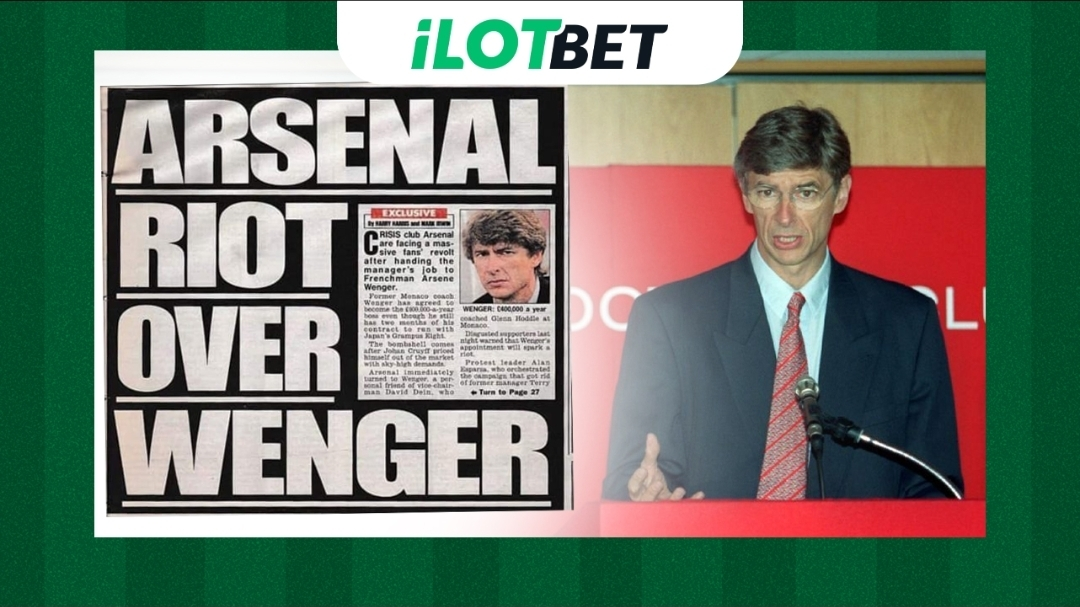

There is a particular kind of silence that follows a joke nobody quite understands. A hesitation. A shrug. A glance around the room to see if anyone else is laughing. And then, slowly, the laughter begins — not because the joke has landed, but because nobody wants to be the only one who didn’t get it.
In October 1996, when Arsène Wenger was appointed manager of Arsenal, English football reacted in much the same way. “Arsène Who?” asked the back pages, with the sort of breezy confidence that only comes from knowing very little and feeling very certain about it.
It is, in hindsight, one of the most unintentionally revealing headlines the game has ever produced. Not because it was wrong — although it was — but because it exposed something deeper about football’s instincts. The game does not fear failure nearly as much as it fears the unfamiliar.
Wenger arrived from Nagoya Grampus with ideas that, at the time, sounded faintly ridiculous. Players should eat differently. Train differently. Think differently. Alcohol was out. Nutrition was in. Recovery mattered. Details mattered. Everything mattered. English football, still basking in the comforting glow of its own traditions, looked at this and saw not innovation, but intrusion.
And so the doubts came. Not always loudly. Not always maliciously. But persistently. Quietly. Like a low hum in the background.
The strange thing about visionaries in football is that they rarely look like visionaries at first. They look like risks. They sound like outsiders. They feel, above all, inconvenient. Because to accept them is to admit that what you have been doing all along might not have been enough.
Wenger did not simply win at Arsenal. He changed the grammar of English football. The pace of the game quickened. Diets improved. Scouting widened. Foreign players were no longer curiosities but necessities. The English Premier League, which now sells itself as the most modern, globalised competition in the world, owes an uncomfortable amount of that identity to a man it once greeted with a punchline.
And yet, this pattern did not begin with Wenger, nor did it end with him.
When Pep Guardiola first began instructing goalkeepers to play out from the back, it was treated as an affectation. When Jürgen Klopp spoke about “gegenpressing” as the best playmaker, it sounded like theory masquerading as practice. Even now, football remains instinctively suspicious of ideas that arrive before their evidence.
Perhaps this is because football, for all its talk of progress, is still deeply conservative at heart. It is a game built on memory. On what worked before. On what felt right. The crowd recognises patterns long before it recognises possibility.
There is also, of course, the small matter of risk. Visionaries demand patience, and patience is the one currency football rarely possesses. Boards want results. Fans want certainty. Media wants answers. A visionary offers none of these immediately. What he offers instead is a kind of promise — intangible, theoretical, and often uncomfortable.
Which is why the easiest response is dismissal.
“Arsène Who?” was not just a question. It was a defence mechanism. A way of protecting the game from the unsettling possibility that someone, somewhere, might understand it better than it understands itself.
By the time Wenger’s Arsenal went an entire league season unbeaten in 2003/04, the question had long since answered itself. The unfamiliar had become inevitable. The risk had become the blueprint.
And yet, even now, football continues to repeat the same ritual. Doubt first. Understand later. Apologise, if at all, in retrospect.
Because the truth is, the game does not struggle to produce visionaries. It struggles to recognise them in real time.
And so somewhere, in some boardroom or training ground or quiet corner of the football world, there is another figure with strange ideas and inconvenient answers, waiting patiently for the laughter to die down.
Waiting, as they always do, to be understood — just a little too late.
Place your bets with iLOTBET today for a chance to become one of the lucky winners of the iPhone 17.