
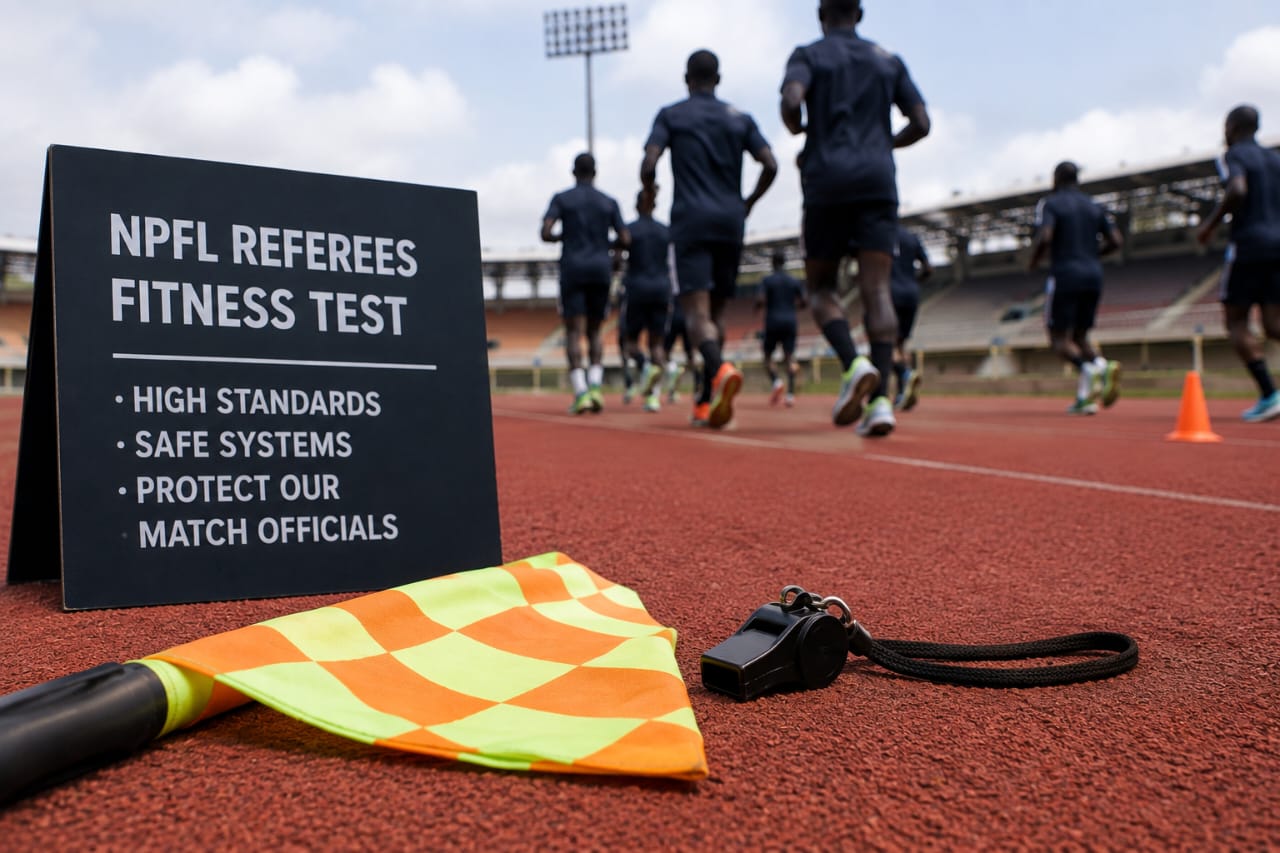
The death of Plateau State referee Aweng Solomon Maram, who reportedly collapsed and died during a pre-season referees’ fitness assessment in Abuja, should not become a blame game.
But it should certainly be an alarm bell.
The tragedy has raised serious questions within the Nigerian refereeing community about the structure, intensity and consequences of the fitness assessment being conducted for officials ahead of the new Nigeria Premier Football League season.
Read Also: Senate Sports Committee Summons NFF, NSC Over Nigeria’s World Cup Failures | Sports247 Nigeria
Information reaching us indicates that medical personnel were available at the venue and that an ambulance was also on ground. Eyewitness accounts suggest that medical officials responded when the referee encountered difficulties.
That is important.
This is therefore not an attempt to blame the medical team or any individual present at the venue. There is no basis, from the information currently available to us, to accuse anyone of negligence.
The bigger question is whether some aspects of the system itself need to be reviewed before another tragedy occurs.
The 10-Lap Question: Why Is Nigeria Demanding 12?
One of the most important issues requiring clarification concerns the physical workload being demanded from referees during the assessment.
Information reaching us is that while a 10-lap benchmark is used for referees in other major competitions, including the FIFA World Cup, and is also understood to be the standard maintained by CAF, referees undergoing the Nigerian NPFL fitness trial are being required to complete 12 laps.
If that information is correct, the obvious question is:
Why is Nigeria demanding 12 laps when 10 laps is considered sufficient at the highest level of international football?
There may be a legitimate technical or scientific reason for the difference.
If there is, the Nigerian refereeing authorities should explain it.
The concern is not that Nigerian referees should not be fit. They absolutely must be.
The concern is whether adding two more laps to an already demanding fitness assessment is based on a scientifically established requirement—or whether the higher benchmark is being used primarily to reduce the number of referees who qualify.
That distinction matters.
Particularly now.
Because when a referee dies during a fitness assessment, every component of that assessment deserves to be examined—not necessarily because somebody is guilty, but because the system must be made as safe as reasonably possible.
FIFA’s approach to elite refereeing places significant emphasis on monitoring referees’ fitness, health and workload, with medical and fitness professionals involved in their preparation.
So the question Nigeria must answer is simple:
What is the scientific and technical justification for the 12-lap requirement?
Is the fitness test becoming a career survival test?
There is another issue that deserves urgent attention.
Information reaching us suggests that the consequences of failing the Nigerian fitness assessment can be severe.
A referee who fails the trial may effectively lose the opportunity to officiate in the NPFL, with limited or no opportunity to return through another assessment under the existing arrangement.
If this is the case, then the policy deserves reconsideration.
A fitness assessment should establish whether a referee is ready to officiate at a particular level at a particular time.
It should not necessarily become a one-day verdict on the entire career of an official.
There should be a clearly defined pathway for referees who fail: medical assessment, fitness rehabilitation, additional preparation and a structured opportunity to retake the test.
Such a system would still protect the integrity of the league while reducing the enormous psychological pressure surrounding the assessment.
When failure means losing everything
The pressure on referees cannot be viewed in isolation from their economic circumstances.
We understand that some referees are still awaiting payments for matches they officiated during the previous NPFL season.
Yet these same officials are now expected to return for another season, meet the requirements of a demanding fitness assessment and compete for the opportunity to continue officiating at the highest level of domestic football.
That creates an enormous burden.
For some referees, they are not simply running a fitness test.
They may feel they are running for their career, livelihood and future in professional football.
That is where the authorities must be particularly careful.
A fitness assessment should encourage referees to prepare properly.
It should not create an atmosphere where an official feels compelled to push beyond safe limits because failure could mean the end of a professional career.
The death of Maram should trigger a review—not a witch-hunt
Nobody should be blamed without evidence.
But equally, nobody should be afraid to ask legitimate questions.
The death of Aweng Solomon Maram should lead to a comprehensive review of the fitness assessment process.
The relevant authorities should clarify the exact protocol used in Abuja, including:
– The required number of laps.
– The distance covered.
– The timing requirements.
– Rest and recovery periods.
– Hydration arrangements.
– Medical screening before the test.
– The criteria for stopping a referee who shows signs of distress.
– The emergency-response procedure.
– The consequences of failing the assessment.
– Whether referees are given a structured opportunity to retest.
Most importantly, the authorities should explain the difference between the 10-lap international benchmark reportedly used elsewhere and the 12-lap requirement being applied to NPFL referees in Nigeria.
If there is a scientific basis for the difference, let it be made public.
If there is a footballing reason, let the refereeing community understand it.
And if the purpose is simply to reduce the number of referees who qualify, then that approach deserves serious reconsideration.
Fitness must never become punishment
There is nothing wrong with demanding high standards from Nigerian referees.
The NPFL needs officials who are physically strong, mentally alert and capable of keeping up with the modern game.
But there is a difference between maintaining a high standard and unnecessarily stretching human limits.
The objective should be to produce referees who are fit enough to officiate at the highest level—and healthy enough to return home after the test.
That is the balance the authorities must get right.
A tragedy must not become just another obituary
Aweng Solomon Maram was not merely a name on a fitness-test register.
He was a referee, a professional, a colleague, a family member and a human being.
His death should therefore not disappear into the cycle of Nigerian football news, where tragedy is reported today and forgotten tomorrow.
There should be an honest examination of what happened.
Not a witch-hunt.
Not finger-pointing.
Not an attempt to manufacture guilt where evidence does not exist.
But a serious, independent and transparent review of the system.
If the medical arrangements were adequate, let that be established.
If the emergency response was appropriate, let that be established too.
But if there are aspects of the fitness protocol, workload, medical screening, recovery process or career consequences that can be improved, this is the moment to identify them and make the necessary changes.
Because the ultimate purpose of football is competition.
The ultimate purpose of refereeing is to serve the game.
And no fitness test should ever become more important than the life of the person being tested.
The alarm has sounded.
The question now is whether Nigerian football will listen.