
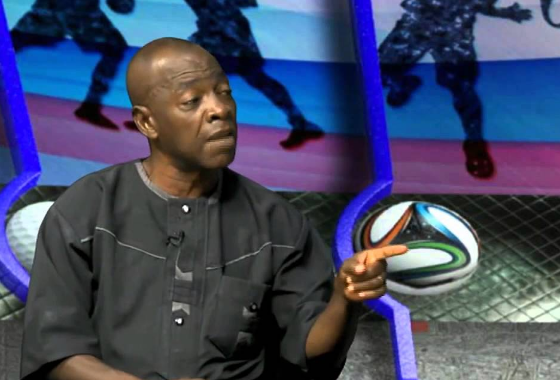
Former Nigeria international and football reform advocate Austin Popo has challenged the newly appointed Nigeria Football Federation (NFF) Normalisation Committee to confront the structural weaknesses undermining Nigerian football, declaring that the country lacks genuinely professional clubs and warning that meaningful reforms must extend beyond conducting another federation election, Sports247.ng reports.
Popo described the committee’s assignment as an enormous responsibility, insisting that expectations are particularly high because of longstanding problems affecting football administration, club ownership and domestic competitions.
“For me, I think it’s a tall order and a tall call, and this is an opportunity for every one of them to be able to prove themselves,” Popo declared.
The former international believes the committee must examine the foundations of Nigerian football rather than concentrate exclusively on leadership changes.
“There’s a lot of expectation, especially when it has to do with our structures, our systems,” he explained.
Popo delivered a particularly damning assessment of the domestic football environment, questioning whether Nigerian clubs meet the structural and ownership standards expected of professional organisations.
“Today, there is no true professional football club in Nigeria in terms of the structure, in terms of ownership,” he claimed.
He argued that the problems extend to league administration and the composition of the NFF itself, where he believes the existing membership structure requires serious examination.
“One area people have been very critical about is in terms of the dominant membership of the state FAs,” Popo stated.
The former international questioned whether the current arrangement provides sufficient opportunities for other football stakeholders to contribute meaningfully to decision-making.
According to him, reforming Nigerian football requires a broader approach that recognises professional expertise and creates opportunities for individuals capable of improving the system.
“There are a lot of things that are being domiciled in the NFF which are not supposed to be there,” he argued.
Popo consequently called for a more inclusive administrative structure that would allow qualified professionals to participate in football governance.
“They should bring more professionals into the system,” he urged.
He also emphasised the importance of fairness, arguing that reforms must create an environment where stakeholders can contribute without unnecessary barriers.
“Give everybody a level playing ground to really make his contribution,” he stated.
With the Normalisation Committee expected to oversee changes to Nigerian football administration, Popo believes its members have an opportunity to address problems that have persisted for years.
For the former international, the ultimate test will not simply be whether the committee conducts elections successfully, but whether it leaves behind stronger clubs, better-administered leagues and a more inclusive federation capable of supporting sustainable football development.