
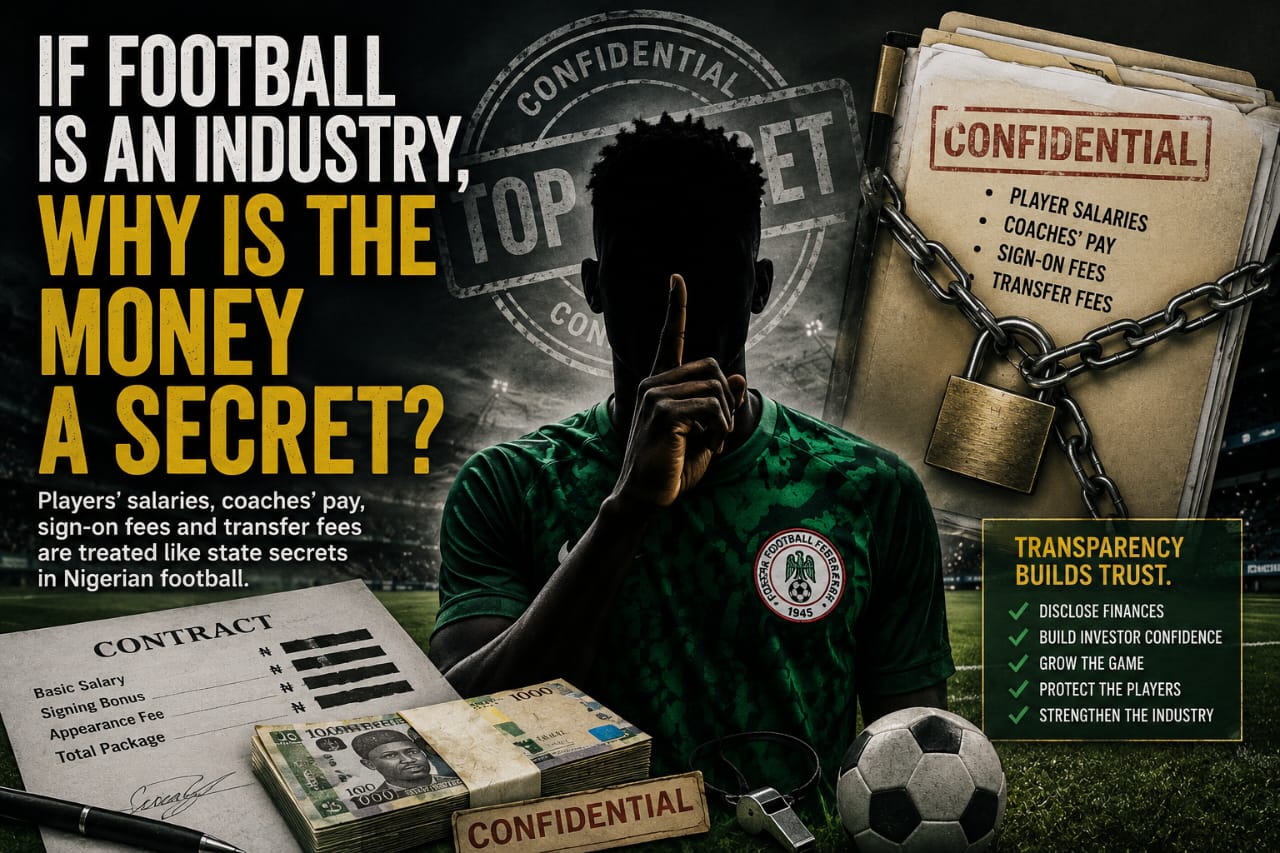
Nigeria keeps telling us that football is an industry.
But there is one question that continues to make that claim difficult to believe:
Where is the money?
In Nigerian football, the salaries of players and coaches, sign-on fees and transfer fees are often treated like state secrets.
Ask what a player signed for and the answer is usually: “It is confidential.”
Ask what a coach earns: “It is confidential.”
Ask how much a club paid another Nigerian club for a player: “It is confidential.”
The usual explanation is security.
Yes, security is a legitimate concern. But if security is the reason, then why does the same secrecy disappear when Nigerian players leave the country?
Take Victor Osimhen.
When Galatasaray signed the Nigerian striker permanently from Napoli, the Turkish club publicly announced a €75 million transfer fee and disclosed the financial terms of his contract, including a €15 million net annual guaranteed salary, alongside other payments.
The same Nigerian footballer. The same sport. The same talent.
But once he crosses the border, the football business suddenly becomes transparent.
Ademola Lookman is another Nigerian international whose transfer negotiations and reported earnings have become public knowledge in the European football market.
So the question becomes unavoidable:
Why does transparency suddenly become possible when Nigerian players leave Nigeria?
Are Nigerian players only at security risk when they play at home?
Or is the bigger problem that our domestic football industry has not developed the financial structures and transparency expected of a professional business?
Nobody is saying every Nigerian player’s exact salary should be posted on social media.
Privacy matters.
Security matters.
But a professional football industry cannot operate entirely in the dark.
The entertainment industry has shown that commercial deals can be discussed publicly. Musicians, actors, comedians and content creators announce major endorsements, partnerships and contracts, while the public can often understand the commercial value surrounding them.
Football should not be different simply because it involves a ball.
The NPFL’s own regulations require clubs to include full remuneration details in player contracts and require clubs to meet their financial obligations to players and other clubs.
Yet we continue to see disputes over unpaid salaries and entitlements.
If football wants serious investors and sponsors, those investors need to understand the business.
How much does a club earn?
How much does it spend on salaries?
How much does it owe players?
How much does it receive from sponsorship?
How much comes from government?
How much was paid for a player?
How much was received when a player was sold?
How much goes to agents?
These questions do not mean exposing sensitive personal information.
They mean making the business of football accountable.
And now that the reported NPFL minimum monthly salary has risen significantly, the need for transparency becomes even more important.
If we want to call football an industry, then we must begin to treat it like one.
Protect the player.
Protect legitimate security concerns.
But protect the credibility of the industry through transparency.
Because you cannot tell investors:
“Come and invest in Nigerian football,”
while also telling them:
“But you cannot know how much clubs earn, what they spend, what they owe or what players are worth.”
That is not how a serious industry grows.
When Victor Osimhen moved abroad, the world knew what Galatasaray paid.
When Nigerian players negotiate in Europe, their transfer values and salaries become part of the football market.
So why should Nigerian football remain a black box?
IF FOOTBALL IS AN INDUSTRY, WHY IS THE MONEY A SECRET?
Perhaps the answer is not to publish every player’s private salary.
Perhaps the answer is to create a system where the player is protected, but the football business is transparent.
Publish audited club accounts.
Publish aggregate wage bills.
Publish transfer fees where appropriate.
Publish outstanding salary debts.
Publish sponsorship and government funding received by clubs.
Publish the financial requirements for club licensing.
Let investors see the market.
Let sponsors understand the value.
Let supporters understand where the money goes.
And let players know that the system protecting their careers is credible.
Because the biggest danger is not knowing whether a player earns ₦5 million or ₦10 million.
The bigger danger is not knowing whether the club can actually afford to pay him.
Nigeria does not need football to be secret.
Nigeria needs football to be professional, transparent and investable.
FOOTBALL CANNOT DEMAND INVESTMENT WHILE HIDING THE BUSINESS