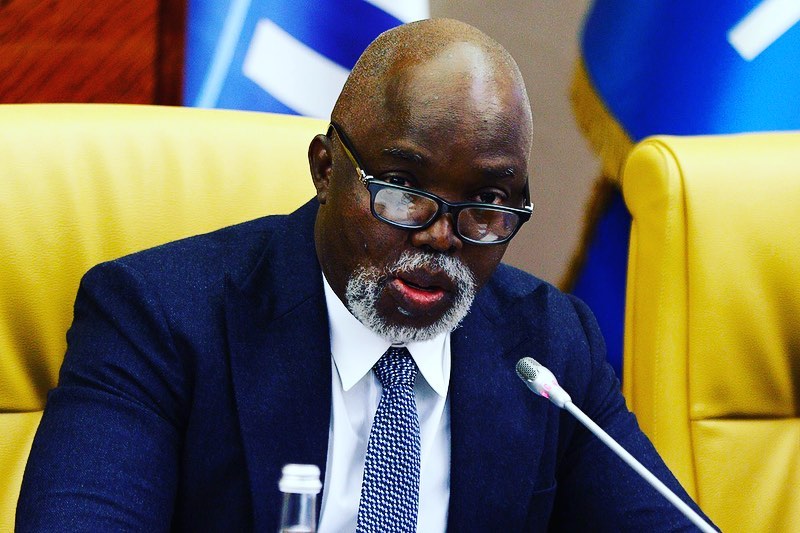
The maiden edition of the Big Sports Dialogue in Ikoyi, Lagos, reached a defining moment on Monday when former President of the Nigeria Football Federation (NFF) and ex-CAF Vice President, Amaju Pinnick, came under intense scrutiny over Nigeria’s tangible benefits from his years in continental and global football leadership.
The dialogue, designed to reappraise Nigeria’s sports sector and address its steady decline—highlighted by the Super Eagles’ failure to qualify for both the 2022 and 2026 FIFA World Cups—brought together key stakeholders from across the industry.
Read Also: Dalung Explodes: ‘Probe the Money! Nigeria Can’t Keep Failing While Funds Disappear!’
Ogunjimi’s Question That Silenced the Hall
Tension rose when Prince Abayomi Ogunjimi, National President of the Authentic Nigeria Football & Allied Sports Supporters Club (ANFASSC), took the microphone. Speaking calmly but firmly, he delivered a question that resonated with many Nigerians.
Directly addressing Pinnick, he asked: “With the powerful position you held at CAF, what exactly did Nigeria benefit from your office? What did your role bring back home to develop Nigerian sport?”
His question created an immediate hush in the room, as administrators, journalists, marketers, and federation officials waited for Pinnick’s response.
Though respectfully phrased, the inquiry reflected widespread public frustration over the perceived disconnect between Nigeria’s global representation and local sports development.
Pinnick Responds
Pinnick, in his response, emphasized the structured nature of FIFA and CAF funding.
“Every money you receive from FIFA comes with a specific purpose. If you don’t comply in 2014, you will not get 2015. Everything is documented. Go and do your studies, go to Zurich and find out what is being given and how money is retired.”
He added that Nigeria’s international image—often associated with corruption and security concerns—has negatively influenced global perceptions, limiting opportunities to host major events.
Monday Kalu’s Follow-Up: The Morocco Comparison
The scrutiny intensified when Monday Kalu, former youth international and sports strategist, posed another pressing question.
He compared Nigeria’s sports progress in the past decade to that of Morocco, a nation widely praised for deliberate planning, infrastructural investment, and strategic execution.
Kalu asked: “If Morocco, within the same period you served as NFF President, could reposition their sports through deliberate planning and infrastructure development, what did you do with the money FIFA gave Nigeria?”
Pinnick again defended his tenure, insisting that the federation operated under strict auditing procedures:
“We were audited by PWC, the number two audit company in the world. You cannot tell them what to do. Everything is captured in the audit. It’s not about saying we received FIFA 1.0; it is documented.”
He maintained that accusations of mismanagement were largely unfounded and reiterated that Nigeria’s credibility suffers when corruption claims go unchecked.
A Defining Moment of Accountability
The exchanges between Pinnick, Ogunjimi, and Kalu became one of the standout moments of the Big Sports Dialogue 1.0.
For many attendees, it symbolized a rare platform where top sports administrators were openly challenged about Nigeria’s stagnation despite its strong global presence.
Two critical questions emerged from the dialogue:
Has Nigeria truly benefited from its representation in international football bodies?
What must change to ensure global influence translates into meaningful domestic development?
Though no definitive answers were provided, the event succeeded in igniting a long-overdue conversation—one that must continue if Nigeria’s collective sports interest is to outweigh the ambitions of a few individuals.
A Roadmap for Reform in View
In his closing remarks, convener Aron Akerejola announced that a comprehensive reform document is currently being developed.
“We are diligently crafting a roadmap for the development of sports in Nigeria,” he said.
“This document will outline concrete actions and milestones that stakeholders can rally behind as we push Nigerian sports to the next level.”
With a robust turnout, candid discussions, and a united call for strategic reforms, the Big Sports Dialogue 1.0 has set the stage for actionable change, positioning sports as a vital instrument for economic growth, national cohesion, and youth empowerment.