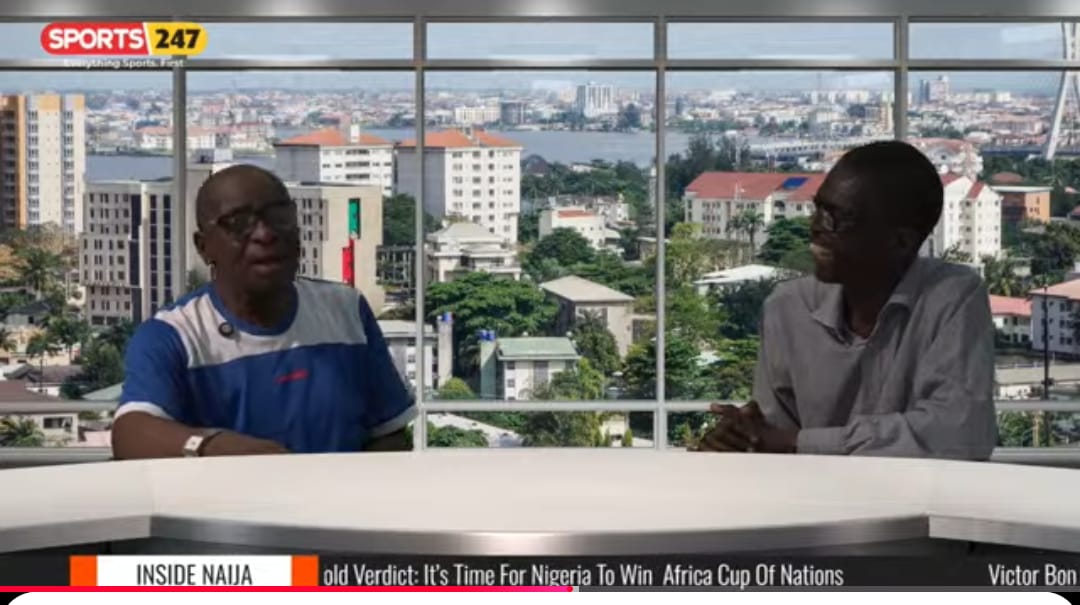
The crew of Sports247 Naija took the former head of Super Eagles’ medical crew, Dr Dipo Odunuga, through a set of questions on our live streaming programme, Inside Naija Sports, which starts at 2:15pm every Friday via YouTube.
The ever articulate, vibrant and highly-vocal retired former head of Lagos National Stadium medical centre went to the past, checked the present and projected into the future in this interview anchored by Sam O’Femi Fasetire.
Read Also: 2026 FIFA World Cup Playoffs: Super Eagles return to training, set for Panthers of Gabon
Q: Good day, sir. You are welcome to the Hot Seat segment of our programme. How are things with you?
A: Thanks for having me. I am okay …. retired but not tired….
Q:That’s great, sir, and we are happy to see you looking fresh after such a long time…
A: …same here…
Q: Okay, doc. Let’s set the ball rolling by asking, what was Nigerian sports generally like back in those days? Was it different compared to what we have nowadays?
A: Yes, everything is now different. What we saw in those days and what we have now should not be compared at all. Back then, you could see complete zeal and passion in what people were doing … including those of us in the medicine sector as well as journalists.
I remember that many journalists at that time would always compete with one another to get interviews and exclusive news.
There were many very committed journalists like Joseph Okujeni of The Guardian. He was eager to get fresh news and always interested in knowing what was going on.
We also were always ready to share the best news with journalists and give the best in our chosen profession. We wanted good things to be reported concerning our department. Unfortunately, it’s not the same these days…
Q: What’s the major difference?
A: It’s simply because people are no longer committed the way we were. Up until the tail end of my service before retirement, I was tired of all that I was seeing. What people are thinking about now is when they will collect the next allowance or when they will travel and issues like that.
In our days, those were not things that we thought about. We first thought about the job during our time; but now it’s all about the money factor.
Q: Let’s talk about the medical centre at the National Stadium in Surulere … when last did you visit that place? What’s it now looking like?
A: I deliberately refused to go there since one of the floodlights fell some two, three years ago. Since then, I have refused to go there because I don’t want to see how rotten the place has now become.
By the time they stopped playing international matches there, the glamour and glory of that place disappeared. So, I have not been there in many, many years gone by.
Q: Hmm. What about the Super Eagles? You were with them for quite a long time…
A: Yes, I started with them in 1980 … the days of Christian Chukwu, Segun Odegbami and Adokie Amasiamaka, whom I served together with during NYSC in Enugu…
Q: Wow. Now, the Super Eagles are going for the World Cup qualification play-offs in Morocco … are you satisfied that Nigeria needs the play-offs before we can qualify for the World Cup?
A: Not at all. I am not happy, because I remember how we used to do better in those days. Before the series of matches in the qualifiers even began, we the officials would have calculated all our bonuses … because we knew the team would win certain games and draw some others.
The team would normally qualify as expected, because the players played with a lot of passion. They used to tell us that they really liked the green and white jersey of the national team. Unfortunately, these days, it is more like we even go to beg them to play for Nigeria.
I was not happy some years ago when the former NFF president, Amaju Pinnick, went to Europe to appeal with the players. That was not how they used to do it in our days.
The players were always ready to play, and there were always at least four players competing for each position. Even home-based players were competing actively for shirts with foreign-based ones.
Q: What were the training sessions like back in those days?
A: There was always stiff competition during training. I remember one incident in 1981, when we were to play a qualifying match against Algeria at the National Stadium. We had Okey Isima as our left full back and John Chiedozie, who was then at Orient FC of England, as our outside right. He was a very fast winger.
Three days before the match, John Chiedozie was messing Okey Isima up in training. So, Okey Isima spoke to him and told him to take it easy, but John Chiedozie did not stop messing him up. So, all of a sudden, Okey Isima kicked him hard, he flew quite high, and then he landed badly on his ankle.
Under one hour, the ankle was swollen, and that was heavy work on me and my colleagues in the medical crew, because Chiedozie had to play the match. We were able to patch him up for the game, but he was not up to 100% fit. He played for only 30 minutes and the coach, Otto Gloria, had to remove him … but we still won the match 3-0.
Q: Talking about injuries in the Super Eagles, considering how Ola Aina, Victor Osimhen and Wilfred Ndidi were recently affected, what advice do you have for the current medical crew regarding the fitness levels of our players?
A: They should just step up their practical efforts and not think mostly about getting match bonuses once we win. For instance, some of them are already taking the play-offs in Morocco as a blessing in disguise … more matches for the team means more money for the crew.
This means the level of professionalism among the players, officials and crew members has dropped. So, they should all be more dedicated and more patriotic. They should put in more effort than just thinking of how much money they would get out of it.
Patriotism is very, very important. Once you are patriotic and you win, a lot of things will follow. As it is, I am very sure that our present government is very interested in rewarding people who come out first … not necessarily thinking about how they get it.
Q: Do you give any form of advice to doctors in the present team?
A: Yes, I do talk with those who are currently there, and we discuss issues regularly. I was happy at a certain time when one of them who went with the team to a country in Latin America called me to ask what could be done about a certain injury that affected one of the players.
I was very happy and I advised him on what to do. So, all they should just do is to face the work and remove their minds from money that comes through match bonuses.
Q: Let’s look at Victor Osimhen and his all-action style of play. Were you to be the team’s doctor, what advice would you give Osimhen?
A: Truly, for someone like Osimhen, the medical crew should help him with important tips about fitness. The only snag, though, would be if the doctors are bold enough to talk to him and if he is humble enough to listen.
During my days, I was opportune to be involved in other sports, not just football. I was even more popular with weightlifting and athletics than soccer. In our days, we didn’t go to the match to watch and enjoy it. Our business is to look out for any injuries that might happen.
We watch our team carefully and see if any player is performing in a particular way that could make him prone to certain injuries, and we advise him accordingly.
Maybe it was because we were more mature among the players, but I found it easy speaking to them. I could tell Segun Odegbami one-on-one, ‘Your ankle can get twisted the way you are playing,’ and he will listen to me.
But, the crew we have nowadays, I’m not sure they have such confidence to talk to the players, or maybe the players too may feel too proud to listen.
Q: That means the relationship between our players and their team doctors is not good enough?
A: It’s just that many of the present officials, not just doctors, see the players as superstars who need to be respected, and they don’t want to offend them.
It’s only the ones who behave like real professionals among the players that would listen to the medical personnel and understand what is being done to assist them. They take instructions from the doctors at their clubs, so they must listen to the Nigerian team’s doctors. The team’s doctors too should not feel inferior to the players and then fail to do the right thing.
Q: Back to the play-off tournament in Morocco … Thursday’s match will see a former Arsenal striker, Pierre-Emerick Aubameyang, play against the Suoer Eagles … should we be scared of him?
A: I don’t think so. Truly, Aubameyang is a good striker, but he’s ageing.
That’s one of the things we doctors consider in sports. As it is, soccer is an explosive sport, and it needs physical aspects to determine results.
I’m not a technical person, but I know Aubameyang no longer has the strength to scare us. A good coach would just ensure that our defenders stretch Aubameyang and knock him a little.
They should just stress him out and ensure that he has to run around for the ball, and I know he cannot run around uninterrupted for 20 minutes.
He will get tired once you force him to run around, and that’s where he’s different from our own top striker, Victor Osimhen, who can run for 120 minutes.
The way Osimhen plays, some people might think he’s on drugs or something like that. But it’s because he’s young,
strong, and determined. He’s naturally strong and he’s still young, unlike Aubameyang.
Q: That means we’ll defeat Gabon. How many goals do you think we’ll score?
A: No, no … I don’t predict, but I know this present team is not a high scoring side. That’s regardless of what they did against Benin Republic … it was simply because those guys were afraid of our players, and they faced the consequences.
Benin Republic had psychological inferiority, which will be different against Gabon. But, I know Nigeria can score at least two goals on Thursday. We should be able to win this game.
Q: What about the final on Sunday? Will it be Cameroon or DR Congo? Will the Super Eagles win this play-off competition?
A: I think it will be Nigeria versus Democratic Republic of Congo in the final, and I know we will beat them. That’s because we are more skillful. However, my fear is after this stage … will we win the intercontinental level as well?
Q: That’s projecting towards March 2026 … but let’s look beyond that into the distant future. Considering that the Golden Eaglets and Flying Eagles have not done well in recent years, how do you think we’ll get talents to replace Osimhen, Ademola Lookman and others in the present Super Eagles’ squad?
A: I suggest that Nigeria should use the Fanny Amun principle. Amun’s blueprint was simply to hunt around all over the country for hidden talents.
I was with him when he was at the 1993 FIFA U17 World Cup in Japan. But, before then, he had already started his build-up in 1991.
Fanny Amun was travelling across all the states in Nigeria, spotting and picking a group of boys who were truly under-17, unlike what we have nowadays. He was able to assemble about 200 players to start with, and he continued sifting them until he got about 30 just before we departed to Japan.
These days, what you see is that they want ready-made players, and they usually source them from the national league. But, I always ask, ‘Can you get under-17 players in our league?’ That, to me, is fraud.
That was what we saw in the last Eaglets’ squad that Manu Garba rushed in putting together. They said the players were from football academies. But, it’s so saddening that even many players in these so-called academies are almost as old as those on the Super Eagles….
Q: … and that sounds very scary because it makes the Super Eagles’ future bleak…
A: Yes it does …
Q: Unfortunately, sir, we have to stop there. We thank you for gracing this maiden edition of Inside Naija Sports, streaming live on YouTube, from the studio of Sports247 Naija. Thanks for being here, sir…
A: Thanks for having me.. .