
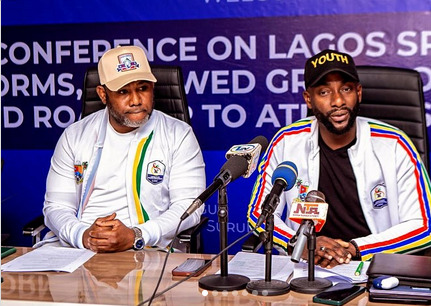
The Lagos State Sports Commission (LSSC) has laid out an ambitious, long-term blueprint to recast the state as Africa’s premier centre for sporting excellence.
Revealed at a media briefing on Friday, the plan leans on three foundational pillars: Sports Development Reforms, a Renewed Grassroots Framework, and a Roadmap to Athletes’ Revitalisation.
Speaking alongside the Commissioner for Youth and Social Development, Mobolaji Ogunlende, LSSC Director-General Lekan Fatodu said Lagos aims to institutionalize systems that will outlast transient administrations, ensuring sustainable growth, accountability, and results in its sporting ecosystem.
Read Also: Iron Wall in Turkestan: Nigerian Shot-Stopper Cynthia Akwasi Makes It Five Straight Clean Sheets for Tomiris-Turan
The reforms include the introduction of an online athlete registration and monitoring portal, biometric profiling and data capture to strengthen identity verification, the establishment of a Team Lagos Monitoring Unit to conduct periodic reviews and publish an annual “State of Team Lagos” report, the dissolution and reboot of the current senior athletes’ structure to be replaced with a more disciplined and performance-driven framework, and a performance-based contract regime for coaches and support staff with clear key performance indicators and continuous education opportunities.
Fatodu noted that grassroots development will play a central role in the new vision. Schools will serve as the nucleus of talent discovery, while partnerships with teachers, parents, and community clubs will be deepened to ensure sports becomes a visible and integral pathway for children. The state also plans to expand sports facilities across all IBILE divisions, build capacity among coaches, and roll out open trials and talent hubs to create a more inclusive state-wide pipeline of prospects.
The third pillar, athletes’ revitalisation, focuses on restoring dignity, career continuity, and empowerment for sportsmen and women. Plans include the introduction of career sustainability programmes to prepare athletes for life after competition, structured exit and probation protocols for underperforming athletes, the appointment of an Athletes’ Liaison Officer to strengthen communication between athletes and administrators, and transparent performance assessment regimes with clear standards and open appeals mechanisms. Fatodu explained that these reforms are a direct response to athletes’ calls for better governance, welfare, and engagement, noting that recent protests had highlighted the urgency for change.
While challenges such as institutional continuity, funding, and accountability remain, the Commission believes that the bold reforms will consolidate Lagos’s dominance in national competitions and build a sports ecosystem capable of standing the test of time. If successfully implemented, the reforms could reposition Lagos not only as a state that dominates in performance but also as a model of structure, inclusion, and integrity in sports administration across Africa.





 has laid out an ambitious, long-term blueprint to recast the state as Africa’s premier centre)